
Indoor Air Quality Decision Guide
Which Indoor Air Quality Solution Is Right?
Air purifiers, UV treatment, humidifiers, and dehumidifiers solve different problems. The right indoor air quality solution starts with understanding what is actually affecting your home—not simply choosing the most advanced equipment.
Different concerns point toward different solutions.
Dust & Particles
Air PurificationHVAC Microbial Concerns
UV TreatmentExcess Humidity
DehumidificationAir That Is Too Dry
HumidificationSome homes have more than one indoor air quality concern. In those cases, the right answer may involve a combination of solutions rather than a single product.
This guide compares the main whole-home indoor air quality approaches and explains which problems each one is designed to address.
The Quick Answer
Start With What You Want to Improve—Then Match the Solution to the Problem
There is no single indoor air quality product that solves every concern. Particle filtration, UV treatment, humidification, and dehumidification each have different jobs.
Dust & Particles
Consider Air Purification
Whole-home filtration is most relevant when airborne particles, recurring dust, or filtration performance are the primary concern.
Microbial Concerns
Consider UV Treatment
HVAC UV equipment becomes more relevant when targeted microbial control inside the heating and cooling system is the concern.
Too Much Humidity
Consider Dehumidification
A whole-home dehumidifier can make sense when indoor moisture remains excessive even though the HVAC system is operating properly.
Air That Is Too Dry
Consider Humidification
Whole-home humidification may help when indoor air becomes consistently too dry and controlled moisture needs to be added.
Sometimes the Answer Is More Than One
Different indoor air quality problems can exist at the same time.
A home might need better particle filtration and humidity control, for example. Combining technologies can make sense when each one has a clearly defined job.
The goal is not to stack IAQ equipment. It is to identify the confirmed concerns and use only the solutions that address them.
Different Problems. Different Solutions.
Indoor Air Quality Is Not One Product
Filtration, UV treatment, humidity control, and other HVAC-integrated solutions each address different concerns. The right approach depends on what is actually happening inside your home.
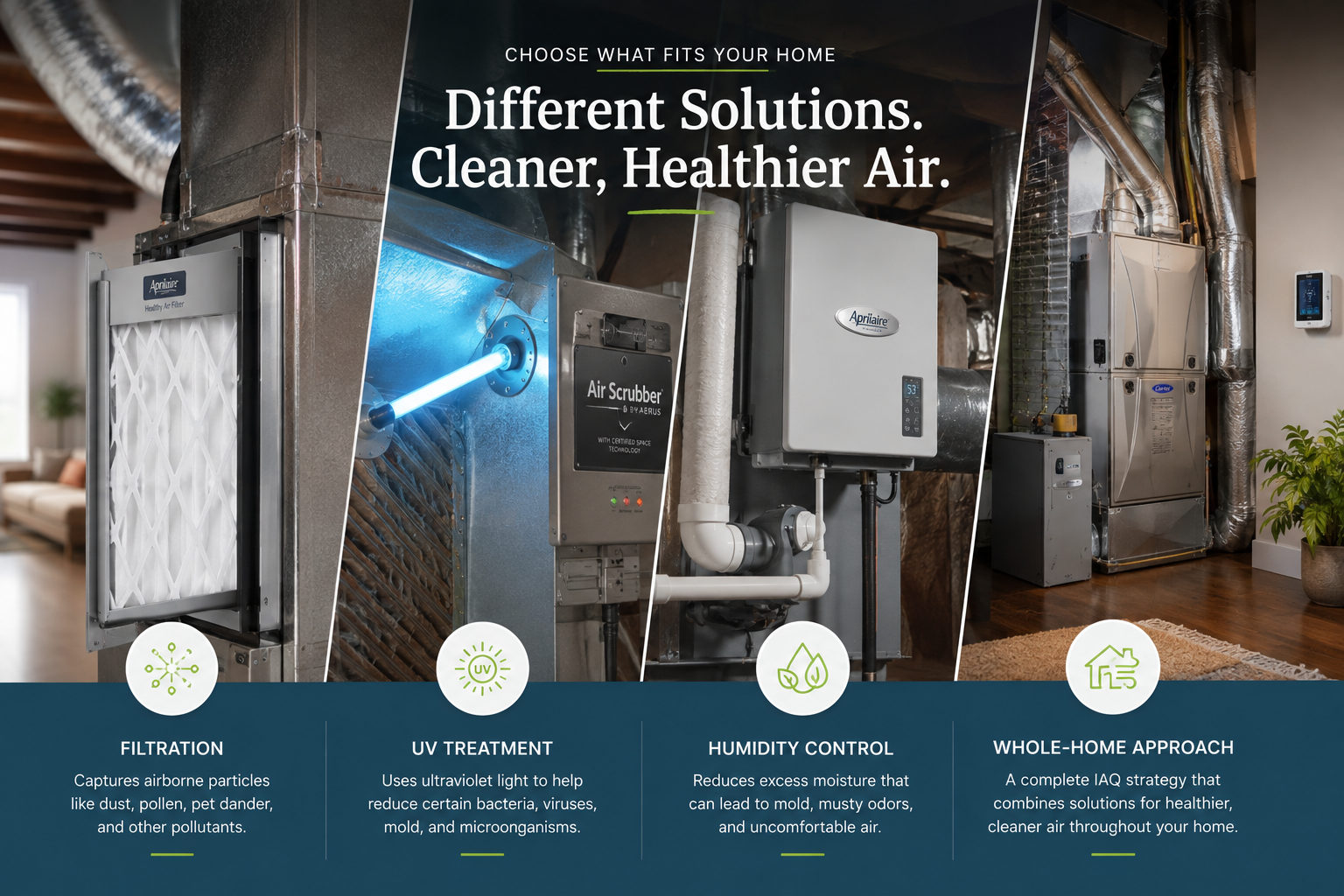
Start With the Concern
The goal is not to install every IAQ product. It is to give each confirmed problem the right solution.
Match the Solution to the Concern
What Are You Actually Trying to Improve?
Indoor air quality equipment works best when it has a clearly defined job. Start with the symptoms or conditions inside the home, then evaluate which technology is designed to address them.
Concern
Recurring Dust or Airborne Particles
Consider
Whole-Home Air Purification
Designed primarily to improve particle filtration as air moves through the HVAC system.Concern
Microbial Growth Around HVAC Components
Consider
UV Treatment
Uses ultraviolet energy at a targeted HVAC location where microorganisms receive exposure to the light.Concern
Persistent Excess Indoor Humidity
Consider
Whole-Home Dehumidification
Provides dedicated moisture removal when normal cooling is not maintaining comfortable humidity.Concern
Indoor Air That Is Consistently Too Dry
Consider
Whole-Home Humidification
Adds controlled moisture to the home's air when indoor humidity remains too low.Concern
Several IAQ Problems at the Same Time
Consider
A Combined IAQ Strategy
More than one solution may be appropriate when the home has multiple confirmed concerns that require different approaches.Diagnose First
The best indoor air quality solution is the one that solves a confirmed problem.
When One Product May Not Solve the Problem
Sometimes the Right IAQ Solution Is Not a Single Piece of Equipment
Indoor air quality problems can overlap. Dust, humidity, odors, HVAC conditions, airflow, ventilation, and moisture sources may all affect how the home feels. That is why the right answer should come from an evaluation—not from choosing a product first.
The Concern Has Not Been Clearly Identified
Dust, odors, humidity, comfort issues, and HVAC symptoms can have very different causes. Installing equipment before understanding the problem can lead to the wrong solution.
Diagnose first
The Existing HVAC System Has a Correctable Issue
Airflow, system operation, filtration, thermostat settings, or equipment performance may contribute to poor indoor conditions and should be reviewed first.
Fix system first
The Problem Is Coming From a Specific Source
Plumbing leaks, moisture intrusion, duct problems, ventilation issues, or household sources may require direct correction rather than another IAQ product.
Source control
More Than One Concern Is Present
A home may have both particle and humidity concerns, for example. One product may improve one part of the problem while leaving another concern unchanged.
Combined strategy
The Existing Equipment Is Already Doing the Job
If filtration, humidity, and HVAC performance are already appropriate, adding more equipment may provide little meaningful improvement.
No added benefit
The Added Complexity Would Outweigh the Benefit
Every IAQ product adds installation requirements, maintenance, controls, and long-term ownership considerations. The benefit should justify the additional system.
Practical value
More Equipment Is Not the Goal
The right indoor air quality strategy solves confirmed problems without adding unnecessary complexity.
Start with the conditions inside the home, understand the cause, and then decide whether one solution, several solutions, or no additional equipment makes sense.
How to Decide
Six Factors Matter Most When Choosing an Indoor Air Quality Solution
The strongest recommendation comes from understanding the primary concern, existing HVAC conditions, filtration, humidity, possible sources, and whether one or several solutions would provide meaningful value.
What Are You Actually Trying to Improve?
Dust, humidity, microbial concerns, dry air, odors, and comfort complaints can point toward very different solutions.
What specific problem should the equipment solve?
What Is Your Current HVAC Filter Already Doing?
Understanding the existing filter, system airflow, and filtration performance helps determine whether additional particle control is actually needed.
Would better filtration solve a meaningful part of the concern?
Is Indoor Humidity Too High, Too Low, or Already Comfortable?
Humidity control requires a different approach than filtration or UV treatment, so actual indoor moisture conditions should be considered.
Does the home need moisture added, removed, or neither?
Can the Existing HVAC System Support the Solution?
Airflow, duct configuration, equipment access, available installation space, controls, and system condition can affect what is practical.
Is the proposed equipment compatible with the home and HVAC system?
Is an IAQ Product Really the Correct Fix?
Duct problems, HVAC performance, ventilation, moisture intrusion, plumbing issues, or household sources may need to be corrected first.
Is the equipment solving the cause—or only treating a symptom?
Would More Than One Solution Address Different Problems?
Filtration, UV treatment, humidification, and dehumidification perform different jobs. Multiple technologies may make sense when multiple confirmed concerns exist.
Would each added solution have a clearly defined purpose?
Start With the Problem
The best IAQ system is not the one with the most equipment. It is the one that addresses the home's actual concerns.
Once the problem, HVAC conditions, humidity, and possible sources are understood, the right technology becomes much easier to identify.
Malek can evaluate the home's current HVAC setup and indoor air quality concerns before explaining which solutions deserve consideration.
Two Different Approaches
Some IAQ Solutions Treat the Air. Others Control the Conditions Around It.
Indoor air quality is broader than filtration alone. Some technologies capture or treat contaminants moving through the HVAC system, while others manage humidity or correct the conditions that may be contributing to the problem.
Air Treatment
Filtration and UV Treatment Focus on What Moves Through or Exists Inside the HVAC System.
Whole-home air purification focuses primarily on capturing particles, while UV equipment applies ultraviolet energy at a targeted HVAC location.
Humidity Control
Humidifiers and Dehumidifiers Change the Moisture Level of the Air.
Dehumidification removes excess moisture, while humidification adds controlled moisture when indoor air becomes consistently too dry.
Source Correction
Sometimes the Right Fix Is Not an IAQ Product at All.
Duct problems, airflow issues, plumbing leaks, ventilation concerns, moisture intrusion, or HVAC performance may need to be corrected before adding indoor air quality equipment.
Whole-Home Strategy
Multiple Technologies Can Make Sense When They Solve Different Confirmed Problems.
A home may need particle filtration and humidity control, for example. The key is making sure each added solution has a clear purpose.
Choose by Function
Every IAQ solution should have a specific problem it is expected to solve.
Choosing the Right Path
Add an IAQ Solution—or Correct the Underlying Problem First?
Indoor air quality equipment makes sense when it has a clearly defined job. If the symptoms are being caused by an HVAC, duct, moisture, or ventilation issue, correcting that problem may be the better first step.
Consider Dedicated IAQ Equipment When the Concern Is Confirmed and the Technology Has a Clear Purpose
This path makes sense when the home has a specific particle, microbial, humidity, or dry-air concern that the selected equipment is designed to address.
- ✓ The primary concern has been identified
- ✓ The HVAC system is operating properly
- ✓ The technology matches the confirmed problem
- ✓ The expected benefit justifies the added equipment
Best when the product has a specific, measurable job within the home's overall HVAC and IAQ strategy.
Correct the Underlying Cause First When the IAQ Concern Is a Symptom of Another Problem
IAQ equipment should not be used to hide airflow, duct, plumbing, moisture, filtration, ventilation, or HVAC performance problems that need their own correction.
- ✓ The source of the concern is unclear
- ✓ HVAC operation or airflow is questionable
- ✓ A moisture or duct issue may be contributing
- ✓ The proposed equipment would only treat part of the symptom
Best when the home needs a clearer diagnosis before any additional equipment is selected.
Questions That Help You Decide
Confirm the concern before choosing the solution.
What is the primary indoor air quality concern?
Is the HVAC system operating correctly?
What is the current filtration setup?
Are humidity levels part of the problem?
Is there an underlying source that should be corrected?
Would each proposed solution have a clearly defined purpose?
Solve the Right Problem
The right IAQ strategy begins with understanding what is actually affecting the home.
Diagnose first, then add equipment only when it clearly addresses a confirmed concern.
Evaluating Indoor Air Quality
How Malek Determines Which Indoor Air Quality Solution Makes Sense
We start with the home and the problem—not a list of products. Then we review the HVAC system, filtration, humidity, possible sources, and equipment compatibility before explaining which options deserve consideration.
Identify the Concern
Understand What You Want to Improve
Dust, humidity, dry air, HVAC conditions, comfort concerns, and other symptoms help establish what the home is actually experiencing.
Review the HVAC System
Make Sure the Heating and Cooling System Is Operating Properly
Airflow, equipment condition, duct configuration, controls, filtration, and system performance can all affect indoor air quality and comfort.
Evaluate Conditions
Review Filtration, Humidity, and Likely Sources
Existing filtration, indoor moisture conditions, ventilation, infiltration, household activity, duct conditions, and other possible sources help narrow the problem.
Compare Solutions
Match Each Confirmed Concern to the Technology Designed to Address It
We compare filtration, UV treatment, humidification, dehumidification, and possible source corrections based on what each option would realistically accomplish.
Explain the Recommendation
Help You Understand What Makes Sense—and What Does Not
We explain the expected benefit, limitations, compatibility, maintenance, and alternatives before recommending any added IAQ equipment.
We Don’t Just Fix It. We Explain It.
We explain what is affecting the home before recommending what should be added.
Need a Clear Recommendation?
Find Out Which Indoor Air Quality Solutions Actually Fit Your Home
Malek can review your indoor air quality concerns, current filtration, humidity, HVAC operation, airflow, duct conditions, and possible sources before explaining which solutions deserve consideration.
What to Expect
-
✓
Your primary indoor air quality concerns reviewed
-
✓
Filtration, humidity, HVAC operation, and likely sources considered
-
✓
Only the solutions that have a clear purpose explained
Continue Exploring
Explore the Indoor Air Quality Solutions Available for Your Home
Once the problem is clear, you can go deeper into the specific technology designed to address it. These are the main whole-home IAQ solutions Malek evaluates with homeowners.
Whole-Home Air Purifiers
Explore HVAC-integrated filtration for homes where airborne particles, recurring dust, or filtration performance are the primary concern.
Explore Air Purifiers →UV Air Purifiers
Learn how targeted UV treatment uses ultraviolet energy in specific HVAC locations when microbial conditions inside the system are a concern.
Explore UV Treatment →Whole-Home Dehumidifiers
Explore dedicated moisture control for homes where excess indoor humidity remains a recurring concern despite normal HVAC operation.
Explore Dehumidifiers →Indoor Air Quality Services
Explore Malek's complete IAQ approach, including filtration, UV treatment, humidity control, evaluation, and whole-home system considerations.
View IAQ Services →Continue Learning
Go Deeper Into the Indoor Air Quality Decisions That Matter
Once you understand which type of solution may fit the problem, the next step is comparing technologies, understanding where each one works best, and deciding whether the added equipment provides enough value for your home.
Whole-Home Air Purifier Cost Guide
Understand what can influence the cost of whole-home air purification, including filtration technology, HVAC compatibility, installation requirements, system configuration, and ongoing maintenance.
Read the Cost Guide →Decision Guide
Portable vs. Whole-Home Air Purifier
Compare room-by-room purification with HVAC-integrated filtration, including coverage, maintenance, installation, and when each approach may make sense.
Decision Guide
Air Purifier vs. UV Light
Learn why filtration and UV treatment perform different jobs, what each technology addresses, and when using both may make sense.
Decision Guide
Is a Whole-Home Dehumidifier Worth It?
Learn when dedicated moisture removal can provide meaningful value—and when an HVAC or moisture-source issue should be addressed first.
Frequently Asked Questions
Indoor Air Quality Solution FAQs
These are some of the most common questions homeowners ask when comparing filtration, UV treatment, humidity control, and other whole-home indoor air quality options.
What is the best indoor air quality solution for a home? +
There is no single best solution for every home. Air purification primarily addresses particles, UV treatment serves a different HVAC-specific purpose, and humidifiers or dehumidifiers manage indoor moisture. The right solution depends on the problem you are trying to solve.
What is the difference between an air purifier and a UV light? +
Whole-home air purification focuses primarily on capturing particles as air moves through the HVAC system. UV equipment uses ultraviolet energy at a targeted location inside the HVAC system. They perform different jobs and are not direct substitutes for one another.
Does an air purifier control humidity? +
No. Air purification and humidity control are separate functions. If excess moisture is the problem, a dehumidifier may be the more relevant technology. If the air is consistently too dry, humidification may deserve consideration.
Does a UV light remove dust and particles from the air? +
No. UV equipment does not function as a particle filter. If dust or airborne particles are the primary concern, filtration or whole-home air purification is generally the more relevant approach.
Can a home need more than one indoor air quality solution? +
Yes. A home may have more than one confirmed concern, such as particle filtration and excess humidity. Multiple technologies can make sense when each one performs a clearly defined job rather than simply adding equipment for the sake of adding equipment.
Does every home need indoor air quality equipment? +
No. Additional IAQ equipment should address a real need. If filtration, humidity, HVAC operation, and indoor conditions are already appropriate, adding more equipment may provide little practical benefit.
Should I fix HVAC or duct problems before adding IAQ equipment? +
Often, yes. Airflow problems, duct issues, moisture sources, filtration problems, ventilation concerns, or HVAC performance issues may contribute to the symptoms. Correcting the underlying cause can sometimes be more important than adding another product.
How does Malek determine which IAQ solution makes sense? +
Malek reviews the homeowner's concerns, existing filtration, humidity, HVAC operation, airflow, duct conditions, likely contributing sources, and equipment compatibility before explaining which solutions may provide meaningful value.
Ready for a Clear Answer?
Understand What Your Home Needs Before Choosing an IAQ Product
Malek can review your indoor air quality concerns, current filtration, humidity, HVAC operation, airflow, duct conditions, and likely contributing sources. We will explain which solutions may provide meaningful value—and which equipment your home may not need.
The Malek Standard
We explain before we recommend.
- ✓ Indoor air quality concerns reviewed first
- ✓ Filtration, humidity, HVAC, and likely sources considered
- ✓ Equipment recommended only when it has a clear purpose
Expertise You Can Feel.