Educational Planning Range
What Does an HVAC UV Air Purifier Typically Cost?
General Residential Planning Range
$500–$3,500+
The investment can vary depending on the type of UV system, number and placement of lamps, HVAC configuration, electrical requirements, installation access, controls, and whether the equipment is designed primarily for coil treatment or broader in-duct air treatment.
This range is provided for general learning and planning purposes only. It is not a Malek quote or guarantee. A relatively simple UV installation at a single HVAC location may fall toward the lower end, while multi-lamp systems, more advanced air-treatment equipment, difficult access, or broader HVAC integration can move the investment higher.
UV systems also should not be compared by price alone. Lamp location, exposure, equipment design, electrical requirements, and the specific HVAC condition being addressed can matter as much as the product itself.
Explore UV Air Purifiers →Compare the Technology
Why HVAC UV Purifier Prices Can Vary So Much
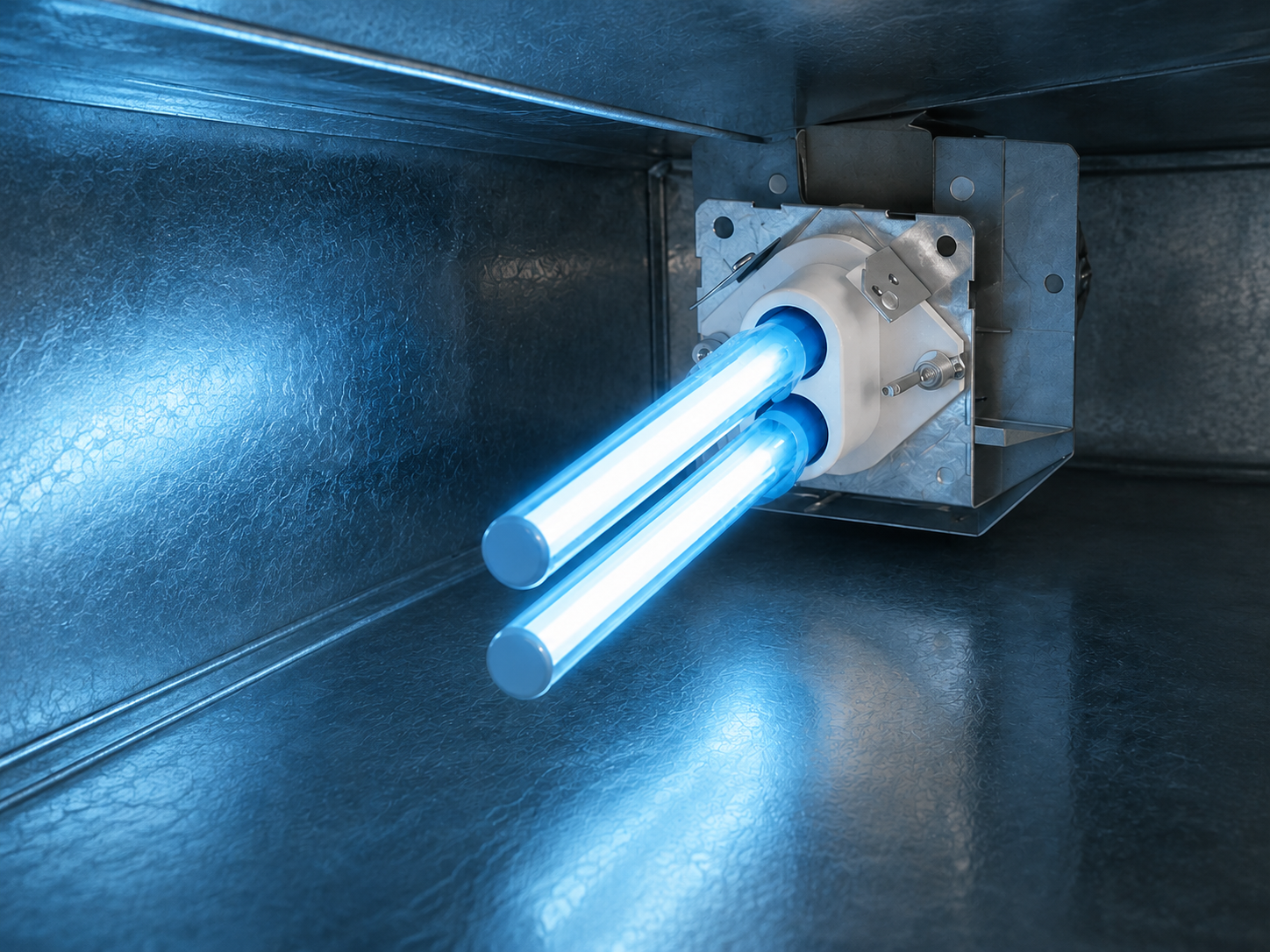
Two UV systems can look similar in a proposal while serving different purposes. One may be positioned near an HVAC coil for continuous treatment of a targeted surface. Another may use one or more lamps in an air stream or duct location where exposure conditions are different.
Pricing therefore depends on the equipment design, number of lamps, placement, electrical requirements, access, HVAC configuration, and whether additional mounting or system modifications are required.
Pricing Variables
What Shapes the UV Air Purifier Investment?
The investment typically reflects the type of UV system, lamp configuration, intended treatment area, HVAC layout, electrical work, controls, access, and ongoing lamp-replacement requirements.
UV System Type
Coil-focused UV equipment and broader in-duct air-treatment systems may use different lamp configurations, mounting strategies, and equipment packages.
Number of Lamps
Single-lamp and multi-lamp systems differ in equipment cost, electrical demand, installation labor, and future replacement costs.
Lamp Placement
UV performance depends in part on where the lamp is positioned and what area receives exposure, making placement an important installation consideration.
HVAC Configuration
Air-handler design, coil location, duct configuration, cabinet materials, and available mounting space can influence which system is practical.
Electrical Requirements
UV equipment requires electrical power, and some installations may involve additional wiring, transformers, controls, or protected connections.
Installation Access
Tight mechanical closets, attic equipment, crowded cabinets, or difficult service access can increase installation complexity.
Number of HVAC Systems
Homes with multiple air handlers may require more than one UV system if treatment is desired at each HVAC system.
Replacement Lamps
UV lamps are service items. Replacement frequency and lamp cost should be considered when comparing long-term ownership.
Understanding the Scope
What May Be Included in an HVAC UV Air Purifier Installation?
The exact scope depends on the selected equipment and where it will be installed. A useful estimate should explain the UV system, intended treatment area, mounting location, electrical requirements, and future maintenance.
HVAC Evaluation
- Review of the existing HVAC system
- Evaluation of accessible coil or duct conditions
- Review of available installation locations
- Discussion of the homeowner's IAQ concern
Equipment Selection
- Selection of appropriate UV system type
- Review of lamp configuration
- Matching equipment to the intended location
- Explanation of lamp maintenance requirements
Equipment Mounting
- Mounting at the selected HVAC location
- Applicable cabinet or duct penetration
- Secure installation of the UV assembly
- Protection of nearby components as applicable
Electrical Connection
- Applicable power connection
- Required wiring or transformer connection
- Applicable controls or safety features
- Verification of equipment operation
System Review
- Review of lamp placement
- Verification of system operation
- Inspection of accessible installation points
- Review of applicable nearby HVAC components
Homeowner Explanation
- Explanation of what the UV system is intended to address
- Replacement-lamp guidance
- Maintenance expectations
- Explanation of what UV treatment does not replace
Not every installation includes every item above. The estimate should identify the type of UV equipment, number of lamps, installation location, electrical requirements, and ongoing maintenance.
Explore UV Air Purifier Installation →Know What Is Separate
What May Not Be Included in a Standard UV Purifier Installation?
UV treatment has a specific HVAC-related function. Particle filtration, humidity control, duct correction, and HVAC repair are separate services that may require their own evaluation.
Air Purification
UV Does Not Replace Particle Filtration
Dust and airborne particle concerns are primarily addressed through filtration. A whole-home air purifier may be quoted separately if particle capture is a primary goal.
Humidity Control
UV Does Not Add or Remove Moisture
Excess humidity or overly dry indoor air requires dedicated humidity control rather than UV treatment.
HVAC Cleaning or Repair
Existing Equipment Conditions May Need Direct Attention
Dirty coils, drainage concerns, airflow problems, equipment malfunctions, or other HVAC conditions may require service before or alongside UV equipment.
Ductwork
Leakage or Physical Damage Is a Separate Issue
Damaged ducts, poor airflow distribution, leakage, or restrictive duct design should be corrected directly rather than expecting UV equipment to solve those problems.
Compare More Than the Bottom Line
How to Compare HVAC UV Purifier Estimates
Before comparing prices, make sure each proposal is using a similar type of UV system and intends to treat the same HVAC area. A simple coil-mounted lamp and a more involved in-duct UV system are not equivalent installations.
What type of UV system is being proposed?
Ask whether the system is primarily intended for a coil or another targeted HVAC location, or whether it is designed for broader in-duct treatment.
Where will the UV lamps be installed?
Placement matters because UV treatment depends on exposing the intended HVAC area to ultraviolet energy.
How many lamps are included?
Confirm whether the proposal includes a single lamp, multiple lamps, or another equipment configuration.
What electrical work is included?
Ask whether wiring, transformers, controls, or additional electrical work are part of the quoted installation.
What maintenance will be required?
Understand replacement-lamp intervals, access requirements, and expected service costs before comparing long-term value.
What does the system not address?
Confirm whether filtration, humidity control, HVAC repair, or ductwork would require separate equipment or service.
A useful UV estimate should explain where the equipment will be installed, what HVAC condition it is intended to address, how it will be powered, and what maintenance will be required over time.
Understanding the Strategy
Coil Treatment or Broader In-Duct UV Treatment?
One of the biggest differences between UV installations is what the equipment is actually positioned to treat. The intended location should be clear before comparing equipment or price.
Coil-Focused UV May Fit When:
- A targeted HVAC surface is the primary concern
- The lamp can remain directed at the intended area
- The equipment configuration provides suitable mounting space
- A simpler UV installation has a clear purpose
- Particle filtration is being handled separately
Broader In-Duct UV May Fit When:
- The system is designed specifically for air-stream treatment
- Multiple lamps or a larger treatment area are appropriate
- The duct configuration supports proper installation
- Electrical and access requirements can be accommodated
- The added complexity has a clearly defined purpose
Neither approach should be selected simply because it sounds more advanced. The appropriate configuration depends on what the UV system is expected to do and where it can be installed effectively.
Read the Air Purifier vs. UV Light Decision Guide →Understanding the Purpose
What Can HVAC UV Treatment Do?
UV equipment is most useful when it is installed for a clearly defined HVAC purpose and positioned where ultraviolet exposure can reach the intended area.
Targeted HVAC Treatment
UV equipment can provide continuous ultraviolet exposure at a selected HVAC location when the system is operating as designed.
Coil-Area Strategy
Some UV systems are installed specifically around an indoor coil or nearby HVAC surfaces where persistent exposure is desired.
HVAC-Integrated Operation
UV treatment operates as part of the central HVAC system rather than requiring a portable device in individual rooms.
Complementary IAQ Strategy
UV can serve a different role from filtration, allowing both technologies to be used when each addresses a separate confirmed concern.
Better Problem Identification
A professional evaluation can help determine whether the concern is actually related to the HVAC area where UV treatment would be installed.
Long-Term IAQ Planning
Understanding UV's specific role makes it easier to separate filtration, humidity control, ductwork, and other IAQ decisions.
Match the Technology to the Concern
Find out whether UV treatment has a clear job to do in your HVAC system.
Malek can review your HVAC configuration, current filtration, equipment conditions, installation locations, and indoor air quality concerns before explaining whether UV treatment makes practical sense.
What to Expect
What Happens During a UV Air Purifier Evaluation and Installation?
Discuss the Indoor Air Quality Concern
The technician reviews what the homeowner wants to improve and whether the concern appears related to filtration, humidity, HVAC conditions, or a location where UV treatment may be relevant.
Inspect the HVAC Configuration
Accessible coil areas, cabinet configuration, ductwork, electrical access, and possible lamp locations are reviewed.
Determine Whether UV Has a Clear Purpose
UV equipment should be recommended only when the intended HVAC location and treatment goal are clearly understood.
Select the Equipment and Placement
Lamp configuration, mounting location, power requirements, access, and future service needs are considered together.
Install and Verify the System
The selected UV equipment is mounted, powered, and reviewed at the defined HVAC location.
Explain Maintenance and Limitations
The homeowner receives guidance on lamp replacement, normal operation, and which IAQ concerns still require filtration, humidity control, or another solution.
When UV Is Not the Whole Answer
When Might Another Indoor Air Quality Solution Make More Sense?
UV equipment has a narrow, specific job. If the primary concern is dust, humidity, airflow, duct damage, or another source, a different solution may be more appropriate.
Dust & Particles
Air Filtration May Be the Better Fit
If particles are the primary concern, whole-home filtration performs the more relevant job because UV equipment does not mechanically capture dust.
Excess Humidity
Dehumidification May Be More Relevant
UV equipment does not remove moisture. Persistent high humidity should be evaluated separately.
HVAC Problem
Repair the Underlying System Condition First
Dirty equipment, drainage problems, airflow restrictions, or other HVAC issues may need direct correction before additional IAQ equipment is added.
Multiple Concerns
A Combined IAQ Strategy May Make Sense
UV and filtration can sometimes be used together when each technology has a separate, clearly defined purpose.
The goal is not to add UV because it sounds more advanced. It is to identify whether ultraviolet treatment is appropriate for a specific HVAC condition and use other IAQ technologies where they perform a different job.
Read Which Indoor Air Quality Solution Is Right? →Use UV With a Clear Purpose
UV treatment should address a defined HVAC concern—not simply become another accessory.
Malek evaluates your HVAC configuration, current filtration, available UV locations, equipment conditions, and indoor air quality concerns before explaining whether UV treatment makes practical sense.
UV Air Purifier Investment FAQs
Questions Homeowners Often Ask About HVAC UV Purifier Cost
These answers explain why UV system pricing varies, how UV treatment differs from filtration, and what installation and maintenance may involve.
How much does an HVAC UV air purifier typically cost?
A broad educational planning range for professionally installed HVAC UV treatment is approximately $500 to $3,500 or more. System type, lamp configuration, HVAC layout, electrical requirements, installation access, controls, and the number of HVAC systems can all affect the final investment. This is general market information and is not a Malek quote or guarantee.
Why do HVAC UV purifier prices vary?
Pricing can vary based on whether the system uses one or multiple lamps, where those lamps are installed, whether the equipment is intended for coil-focused or broader in-duct treatment, and what electrical or mounting work is required.
Is a UV air purifier the same as a whole-home air purifier?
No. Whole-home filtration primarily captures particles moving through the HVAC system. UV equipment uses ultraviolet energy at a targeted HVAC location. They perform different jobs and are not direct substitutes.
Does UV treatment remove dust from the air?
No. UV equipment does not mechanically capture dust or other particles. If particle filtration is the primary concern, a properly selected HVAC filter or whole-home air purification system is the more relevant technology.
What is the difference between coil UV and in-duct UV?
Coil-focused UV systems are positioned to provide ultraviolet exposure at a targeted HVAC surface such as an indoor coil area. In-duct systems may use a different lamp configuration intended for treatment within the air stream or ductwork. Equipment design and placement should match the intended purpose.
Do HVAC UV lamps need to be replaced?
Yes. UV lamps are service items and their ultraviolet output changes with use. Replacement requirements depend on the specific equipment and manufacturer guidance, so ongoing lamp cost should be considered when comparing systems.
Can UV treatment control humidity?
No. UV treatment does not add or remove moisture. Humidity problems require a separate evaluation and may involve dehumidification, humidification, HVAC correction, or another moisture-related solution.
How does Malek determine whether UV treatment makes sense?
Malek reviews the homeowner's indoor air quality concern, current filtration, HVAC configuration, accessible equipment conditions, potential UV installation locations, electrical requirements, and equipment compatibility before explaining whether UV treatment may provide meaningful value.