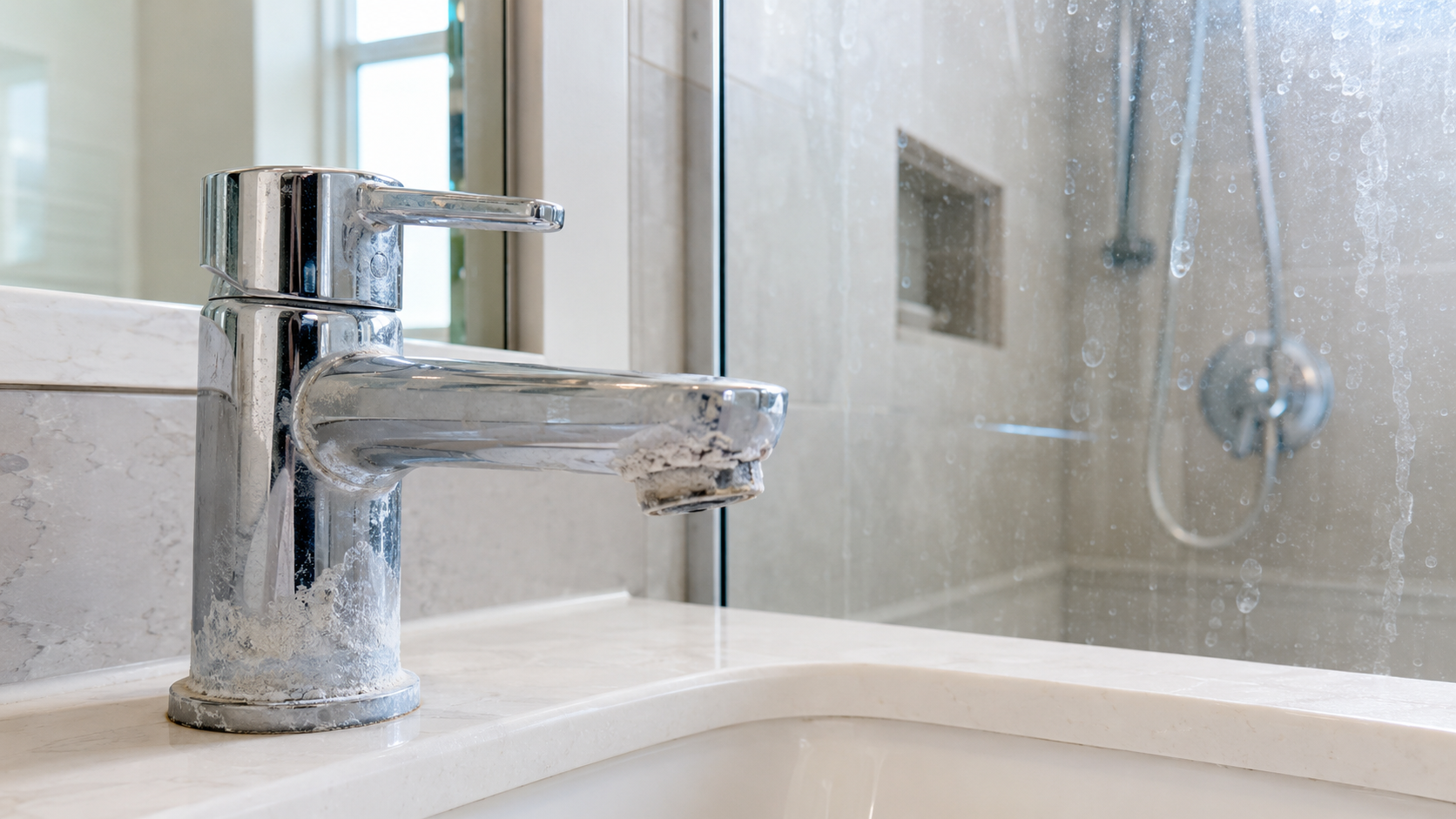
Common signs of hard water include white scale around faucets and showerheads, spots on dishes, soap that does not lather well, recurring film on bathroom surfaces, and mineral buildup around water-using equipment.
These symptoms may point toward elevated calcium and magnesium, but no single sign confirms hardness. Testing the water is the best way to determine the hardness level and whether a softener is the right solution.
What Homeowners Commonly Notice
Six Signs That May Be Associated With Hard Water
White Scale Buildup
Chalky deposits around faucets, showerheads, and drains can form as mineral-containing water evaporates.
Spots on Dishes and Glassware
Recurring spots or cloudy-looking film after washing may be caused by hardness minerals, although detergent and dishwasher settings can also contribute.
Poor Soap Lather
Hardness minerals can react with soap, making it harder to build lather and leaving more residue behind.
Soap Film in Tubs and Showers
A stubborn film on tile, glass, sinks, and fixtures may develop when soap combines with hardness minerals.
Dry-Feeling Skin or Hair
Some homeowners notice that soap rinses differently in hard water, but skin and hair symptoms alone do not prove hardness.
Mineral Deposits Around Equipment
Scale may collect around water-heater connections, coffee makers, humidifiers, ice makers, and other water-using equipment.
Fixtures and Surfaces
Scale Often Appears Where Water Evaporates or Heats
White or crusty buildup can restrict flow and make the water stream uneven.
Mineral deposits may partially block spray openings and reduce or redirect water flow.
Hardness minerals can leave a cloudy film that returns after the surface dries.
Scale can collect around drain openings and along areas where water regularly sits or evaporates.
Mineral rings or deposits may form over time, although staining can also come from iron, manganese, or other water conditions.
Visible deposits around valves and fittings may indicate evaporation, a small leak, hardness, or more than one condition at once.
Soap, Cleaning, and Laundry
Hardness Minerals Can Change How Soap and Detergent Perform
More Soap or Detergent Is Needed
Hard water can reduce lather and cleaning efficiency, leading homeowners to use more product than expected.
Soap Residue Is Harder to Rinse
Soap can combine with minerals and leave film on tubs, sinks, tile, glass, and skin.
Laundry Feels Stiff or Dull
Mineral residue and detergent performance may affect how fabrics feel and appear after washing.
Dishes Need Extra Rinsing
Mineral spotting may remain after the dishwasher cycle, especially when rinse aid, detergent amount, or water temperature are not optimized.
Equipment and Plumbing
Scale Can Affect More Than the Surfaces You See
What You May Notice
- Scale around faucet aerators and showerheads
- Recurring residue on sinks and glass
- Deposits around appliance connections
- Reduced spray pattern or fixture flow
- Frequent cleaning of mineral buildup
What May Be Happening Out of Sight
- Scale inside a tank-style water heater
- Mineral accumulation on heating surfaces
- Deposits in valves and small water passages
- Reduced efficiency in certain water-using appliances
- More frequent maintenance where scale collects
What You Can Safely Check at Home
Inspect several fixtures. Compare faucets, showerheads, sinks, and glass surfaces in different rooms.
Clean one area completely. Watch how quickly the white residue or film returns.
Check hot and cold water. A condition limited to hot water may involve the water heater rather than the entire supply.
Look at the water heater. Note recurring sediment, popping sounds, or scale around visible connections.
Review existing equipment. Confirm whether a softener is bypassed, unplugged, out of salt, or overdue for maintenance.
Write down where symptoms occur. A clear pattern helps a professional distinguish whole-home hardness from a localized issue.
Why Testing Matters
A Hardness Test Replaces Guesswork With a Measurable Result
Testing helps confirm whether the symptoms are related to calcium and magnesium and provides the information needed to size and program a softener correctly. The result should be considered along with the water source, household size, plumbing conditions, and any other water-quality concerns.
A measured result helps determine whether softening is appropriate and how much treatment capacity may be needed.
Taste, odor, sediment, iron, chlorine, and discoloration may require filtration or another treatment method.
Hardness, household water use, peak flow, and regeneration needs all affect equipment selection.
Testing may show that maintenance, filtration, a localized repair, or no treatment at all is the better next step.
Confirm What You Are Seeing
Find Out Whether Hard Water Is Causing the Buildup
Malek can review the symptoms, evaluate the water source and plumbing conditions, test the water, and explain whether softening or another treatment approach makes sense for your home.
When to Schedule Service
Professional Evaluation Makes Sense When the Pattern Is Recurring or Affecting Equipment
Schedule a Water Quality Evaluation When
- Scale returns quickly after cleaning
- Several fixtures show the same pattern
- Water-heater sediment or scale is recurring
- An existing softener is not performing consistently
- You are comparing softening and filtration options
Schedule Plumbing Service Promptly When
- Water pressure has changed suddenly
- A valve, fixture, or connection is leaking
- Discoloration appears suddenly or only at one fixture
- The water heater is leaking or making severe new noises
- The water has a sudden unusual taste or odor
What a Professional Evaluates
The Goal Is to Identify the Cause Before Recommending Equipment
The evaluation compares multiple fixtures, hot and cold water, and whole-home versus localized patterns.
Testing helps separate mineral hardness from sediment, iron, chlorine, taste, odor, and other concerns.
Municipal and private-well systems may require different testing, treatment, and maintenance considerations.
A current softener or filter may need service, cleaning, reprogramming, media replacement, or repair.
Fixtures, valves, water heaters, appliances, and visible plumbing are reviewed for scale-related effects and separate repair needs.
System capacity, salt use, regeneration, filter changes, access, and long-term upkeep should be clear before a recommendation is made.
Frequently Asked Questions
Common Questions About Hard-Water Signs
What does hard-water buildup look like?
Hard-water buildup often appears as white, chalky, or crusty residue around faucets, showerheads, drains, glass, and other surfaces where water evaporates.
Do spots on dishes always mean hard water?
No. Hardness minerals are a common cause, but detergent amount, rinse aid, dishwasher temperature, drying conditions, and permanent glass etching can also affect appearance.
Can hard water make my skin or hair feel dry?
Some homeowners notice that soap rinses differently in hard water, but skin and hair symptoms can have many causes and should not be used alone to diagnose hardness.
Can hard water reduce water pressure?
Scale can restrict small openings in aerators, showerheads, valves, and certain equipment, but a sudden pressure change may have another plumbing cause and should be evaluated.
Can hard water affect my water heater?
Hardness minerals can contribute to scale and sediment inside a water heater, especially on heating surfaces. The amount of impact depends on the water, equipment, temperature, and maintenance history.
Is white residue always caused by hard water?
No. White residue may come from hardness minerals, cleaning products, salt, or another source. Testing and the location of the buildup help narrow the cause.
How do I know how hard my water is?
A hardness test provides a measurable result. That result can be used with household water use and plumbing conditions to evaluate whether a softener is appropriate.
Will a water softener fix every water-quality problem?
No. A softener primarily reduces calcium and magnesium hardness. Taste, odor, sediment, chlorine, iron, or drinking-water concerns may require filtration or another treatment method.