Water Softener Investment Guide
What Does a Professionally Installed Water Softener Typically Cost?
Many professionally installed whole-home water softener projects begin around $2,500. The final investment depends on measured hardness, household demand, system capacity, control type, plumbing access, drain and electrical availability, installation location, and any additional treatment needs.
This guide provides a practical planning number while explaining what can move the project above it. The goal is to help homeowners compare complete installed value—not a low equipment price that leaves out the plumbing, setup, testing, and long-term support required for the system to perform properly.
Educational Planning Range
Many Professionally Installed Whole-Home Water Softeners Begin Around $2,500+
General Residential Starting Investment
$2,500+
Many standard whole-home water softener installations begin around this level when the home has suitable main-line plumbing, a practical installation location, nearby drainage and electrical access, and no major pretreatment or plumbing modifications.
This starting investment is provided for general learning and planning purposes only. It is not a quote or guarantee. The actual investment depends on measured hardness, household demand, required capacity, equipment configuration, installation access, plumbing changes, drain routing, electrical needs, and any additional water-quality concerns.
Existing Softener Replacement
This is often the most direct path when the home already has a suitable softener loop, bypass, drain, electrical access, and installation space that can be reused.
New Whole-Home Installation
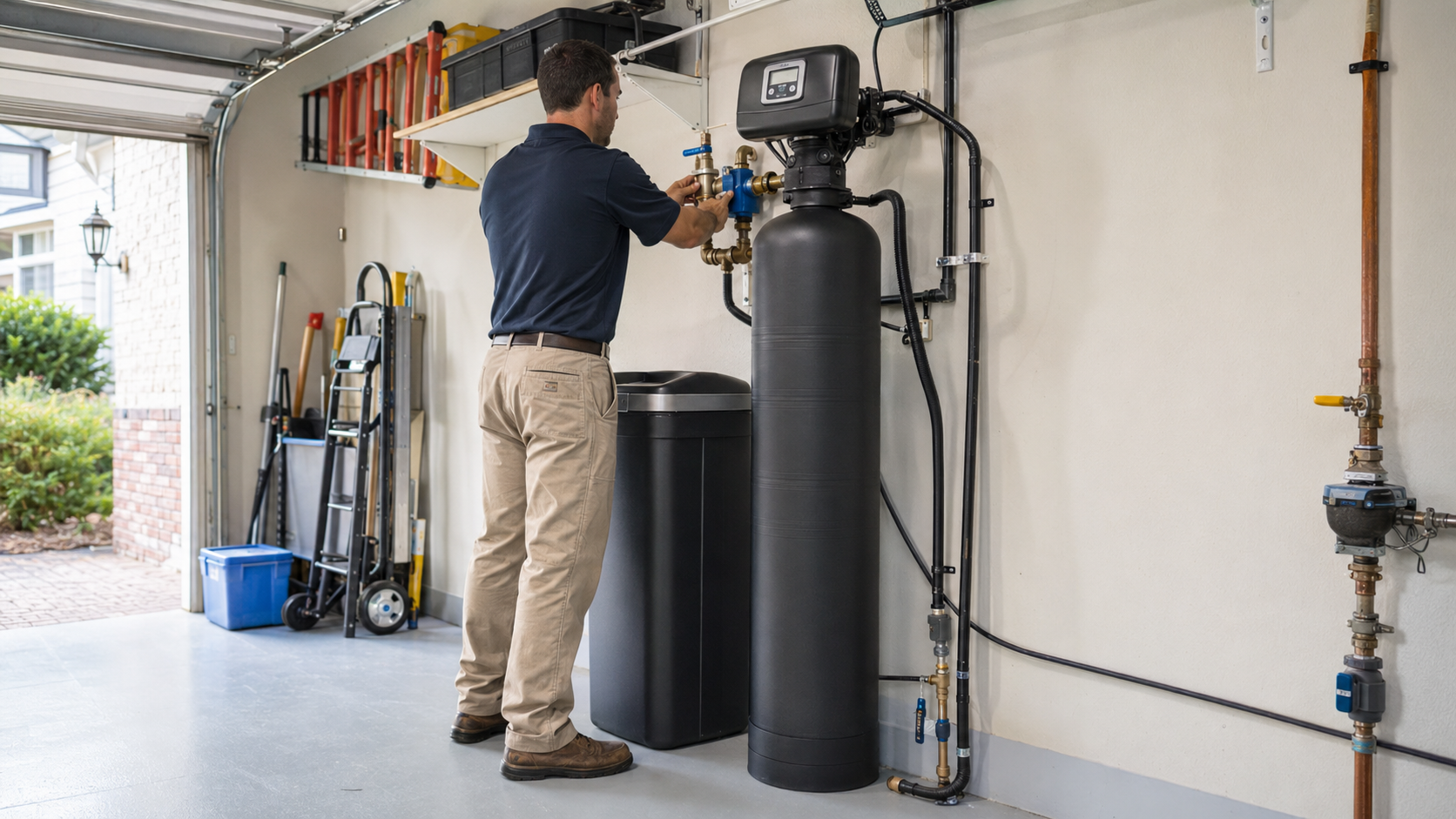
The investment may increase when the home needs new main-line plumbing, a bypass, drain routing, electrical access, equipment protection, or a different installation location.
Combined Treatment System
A home with hardness plus sediment, chlorine, iron, odor, or other concerns may require filtration or pretreatment in addition to softening.
The $2,500 starting point applies to a professionally supplied and installed whole-home softener—not every advanced, high-capacity, twin-tank, combined-treatment, or infrastructure-heavy project.
Major Cost Factors
What Can Change the Final Water Softener Price?
Measured Hardness
Higher hardness creates a greater mineral load and may require more capacity, more frequent regeneration, or a different system configuration.
Household Water Use
The number of occupants, bathrooms, fixtures, and daily water use affects the amount of treatment capacity needed between regeneration cycles.
Peak Flow Demand
Multiple showers, appliances, and fixtures operating at the same time can require a larger valve or system capable of maintaining adequate flow.
Equipment Configuration
Cabinet-style, separate-tank, single-tank, twin-tank, and advanced-control systems differ in capacity, serviceability, efficiency, and price.
Plumbing Access
A nearby main water line and existing softener loop usually make installation more direct than a project requiring long plumbing runs or difficult access.
Drain and Electrical Access
Most modern softeners require a proper regeneration drain and a nearby electrical receptacle. Adding either can increase the installation scope.
Installation Location
Tight closets, exterior locations, crawlspaces, or other difficult-to-service areas can affect labor, materials, and future maintenance access.
Additional Water Conditions
Sediment, chlorine, iron, odor, or other concerns may require filtration or pretreatment before the softener can perform as intended.
Equipment vs. Installed Price
The Water Softener Is Only One Part of the Total Investment
Equipment Cost
The System Itself
- ✓Resin tank and treatment media
- ✓Control valve and programming
- ✓Brine tank or cabinet assembly
- ✓Capacity, efficiency, and warranty
Installed Cost
Everything Required to Complete the Installation Correctly
- ✓Plumbing connections and bypass
- ✓Drain and electrical requirements
- ✓Removal of existing equipment when applicable
- ✓Testing, startup, programming, and explanation
Possible Installation Additions
Items That May Appear on a Water Softener Estimate
New Softener Loop
A home without a dedicated loop may need new supply and return piping so the intended water can be treated.
Bypass and Isolation Valves
A proper bypass makes service, maintenance, and emergency isolation easier.
Drain-Line Work
Regeneration discharge must be routed to an appropriate drain location.
Electrical Receptacle
A nearby power source may be needed for the control valve.
Pressure or Flow Corrections
Existing pressure, flow, or plumbing restrictions may need to be addressed before installation.
Equipment Platform or Protection
Some locations may require a stable base, weather protection, or changes that improve service access.
Pretreatment Filtration
Sediment, iron, chlorine, or other conditions may require treatment before the softener.
Removal of Existing Equipment
Old tanks, plumbing, and unused connections may need to be removed or modified.
Standard vs. Advanced Systems
Why Some Water Softeners Require a Different Investment Conversation
Single-Tank Metered Softener
This configuration works well for many homes when the system is correctly sized and programmed around measured water use.
Often the more direct installation path
Twin-Tank or Advanced-Control System
Higher-demand homes may benefit from continuous soft water, additional capacity, or more advanced controls, but the added equipment should be justified by actual use.
Often a higher-capacity option
More equipment is not automatically better. The right system depends on hardness, demand, flow, installation conditions, and maintenance expectations.
Getting an Accurate Estimate
Questions a Water Softener Evaluation Should Answer
What is the measured hardness level?
How much water does the household use?
What peak flow rate must the system support?
Is an existing softener loop available?
Are drain and electrical connections nearby?
Are other water conditions present?
What maintenance and salt use should be expected?
What is included in the installed price?
Comparing Estimates
Make Sure You Are Comparing the Same Scope of Work
Measured hardness and sizing basis
Exact system capacity and configuration
Control valve and programming features
Plumbing, bypass, drain, and electrical work
Removal of old equipment when applicable
Startup, testing, and homeowner walkthrough
Warranty and future service support
Maintenance, salt, and operating expectations
The Bottom Line
A Starting Price Is Useful Only When the System and Installation Scope Are Clear
A professionally installed whole-home water softener may begin around $2,500, but measured hardness, household demand, equipment capacity, plumbing access, drain and electrical requirements, and additional treatment needs determine the actual project.
Homeowners should understand why a specific system is being recommended, how it was sized, what installation work is included, and what maintenance will be required.
At Malek, the goal is to make the decision clear before the work begins. We explain the water conditions, the equipment, the installation needs, and what each option is likely to mean for the home.
We Don’t Just Fix It. We Explain It.
What Malek Includes
A Water Quality Evaluation Should Explain the Full Scope
The goal is not to hand over a number without context. Malek evaluates the water, household demand, existing plumbing, and installation conditions so the estimate reflects the actual project.
Water Conditions
Test the Water and Review the Symptoms
We review the homeowner’s concerns, water source, visible conditions, and measured hardness before recommending equipment.
Household Demand
Confirm What the Home Actually Needs
We consider occupants, bathrooms, fixtures, daily water use, and peak demand so the system is sized appropriately.
Installation Conditions
Inspect Plumbing, Drainage, Electrical Access, and Space
The evaluation includes the main line, softener loop, bypass, drain route, power source, equipment location, and service access.
System Options
Compare Practical Treatment Paths
We explain whether a standard softener, advanced configuration, repair, or combined treatment approach makes sense.
Project Scope
Explain What the Estimate Includes
The estimate should identify the equipment, installation materials, plumbing work, startup, programming, and known factors that could change the scope.
Planning the Investment
Water Softener Cost Should Be Clear Before the Work Begins
The $2,500 starting investment is only a planning point. A complete estimate should explain the recommended system, installation work, included materials, and any conditions that could affect the final scope. Malek also offers financing options for qualified homeowners who prefer to spread the investment over time.
Related Water Quality Services
Explore the Service Behind the Investment
These pages explain water softening, filtration, reverse osmosis, and the broader water-quality service path in more detail.
Softening
Water Softener Services
Learn how Malek evaluates hardness, capacity, installation conditions, and whole-home softening options.
Explore Water Softeners → 02Filtration
Whole-Home Water Filtration
Understand how filtration addresses sediment, chlorine, taste, odor, and other treatment goals beyond hardness.
Explore Filtration → 03Drinking Water
Reverse Osmosis Systems
Review point-of-use drinking-water treatment, installation needs, and ongoing filter and membrane maintenance.
Explore Reverse Osmosis → 04Service Hub
Water Quality Services
See all water-quality service options, common symptoms, treatment choices, and next steps in one place.
View All Services →Frequently Asked Questions
Water Softener Cost FAQs
These answers explain why water softener estimates vary and what homeowners should look for when comparing project costs.
What affects the cost of a water softener?+
The main factors include measured hardness, household water use, system capacity, control type, installation location, plumbing access, drain and electrical requirements, and any additional treatment needs.
Does every water softener project start around $2,500?+
No. The $2,500 figure is a broad educational starting point for a professionally supplied and installed whole-home softener. The actual investment may be lower or higher depending on system capacity, plumbing access, drain and electrical requirements, installation location, pretreatment needs, and the condition of the existing setup.
Why can two water softener estimates be very different?+
Estimates may include different capacities, control valves, resin volumes, warranties, plumbing work, drain routing, electrical work, bypass arrangements, startup, and future service support.
Does a larger water softener always cost more?+
Larger systems often cost more, but capacity should be matched to the measured hardness and household demand. Oversizing can increase cost without improving performance.
What installation work can increase the cost?+
New main-line plumbing, a softener loop, bypass valves, drain routing, electrical access, difficult equipment locations, and removal of old equipment can increase labor and materials.
How much does salt add to the long-term cost?+
Salt use depends on hardness, water use, system capacity, efficiency, and programming. A properly sized metered system should regenerate based on actual demand.
Can financing be used for a water softener?+
Financing options may be available for qualified homeowners. Approval, terms, and payment options depend on the lender and selected project.
Can I get an exact price without an evaluation?+
A responsible exact price usually requires confirmation of the water hardness, household demand, plumbing access, drain and electrical availability, and any additional treatment needs.
How do I know whether my existing softener should be repaired or replaced?+
Repair may make sense when the system is correctly sized and the issue is limited to a replaceable control, seal, motor, or valve component. Replacement deserves comparison when the system is undersized, unreliable, heavily worn, or no longer suited to the water.
Get a Clear Water Softener Estimate
Understand the Water, the System, and the Investment Before You Decide
Malek will evaluate the water, review household demand, inspect the installation conditions, explain the available treatment options, and provide a clear scope before approved work begins.