Indoor Air Quality Problem Guide
Why Are My Allergies Worse Indoors?
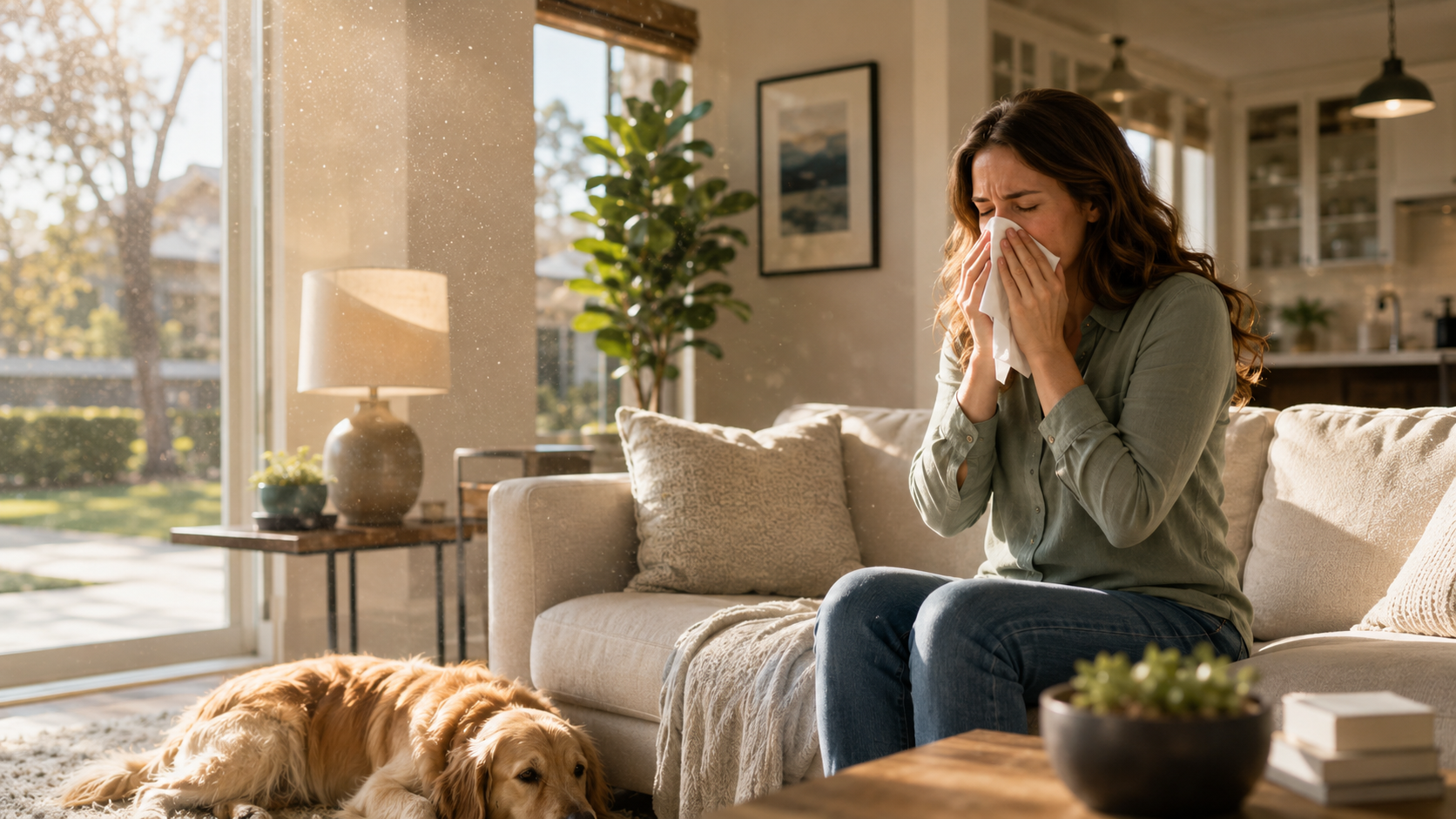
If sneezing, stuffiness, itchy eyes, or other allergy symptoms seem worse when you are inside your home, the environment around you may contain allergens that are different from — or more concentrated than — what you encounter outdoors.
Dust mites, pet allergens, pollen that has traveled indoors, mold, household dust, and pest allergens can all be present inside a home. Your HVAC system does not create most of these allergens, but filtration, humidity, airflow, and duct conditions can influence how some particles move through the house.
This guide explains common indoor allergy triggers, what patterns may help you identify a home-related concern, what you can safely observe, and where HVAC or indoor air quality improvements may fit alongside appropriate medical guidance.
The Quick Answer
Indoor Allergy Symptoms Can Be Influenced by What Is Already Inside the Home
Allergens Can Accumulate Indoors
Dust mites, pet allergens, household dust, mold, and pest allergens may remain inside the home instead of dispersing as quickly as outdoor particles.
Outdoor Allergens Can Come Inside Too
Pollen and outdoor particles can enter on clothing, shoes, pets, through open doors and windows, and through small openings in the home.
HVAC Conditions Can Affect Distribution
Filters, airflow, humidity, and duct conditions can influence how airborne particles circulate through different rooms.
Indoor air quality improvements may help reduce exposure to certain airborne particles, but they are not a diagnosis or treatment for allergies. Persistent or significant symptoms should be discussed with an appropriate healthcare professional.
Common Indoor Triggers
7 Things Inside a Home That May Contribute to Allergy Symptoms
Dust Mites
Dust mites are microscopic organisms commonly associated with household dust. They tend to be found in bedding, mattresses, upholstered furniture, carpeting, and other soft materials.
Moisture matters because dust mites generally do better in warm, humid environments. Keeping indoor humidity under control can therefore be one part of reducing conditions that support them.
Pet Allergens
Pet-related allergens are not limited to visible hair. Proteins associated with animal dander, saliva, and urine can remain on furniture, carpet, bedding, clothing, and other household surfaces.
Normal movement through the home can disturb some of those particles and make them airborne again.
Pollen That Has Traveled Indoors
Closing the front door does not completely separate your home from outdoor pollen. Pollen can enter through doors and windows or travel inside on clothing, shoes, hair, and pets.
During heavy pollen periods, outdoor allergens can become part of the dust and particles already circulating inside the home.
Mold and Persistent Moisture
Mold can develop where moisture remains available, including areas affected by leaks, condensation, water damage, or persistent humidity.
The first priority with a moisture-related problem is identifying and correcting the source. HVAC humidity control can be relevant when elevated indoor humidity is part of the larger issue.
Learn more about whole-home dehumidification .
Household Dust
Household dust is a mixture of material from both indoor and outdoor sources. It can include fibers, soil, skin flakes, pollen, pet material, and other fine particles.
If your home becomes dusty very quickly, understanding the source can be more useful than assuming the HVAC system itself is producing the dust.
See our guide: Why Is My House So Dusty?
Pest Allergens
Cockroaches, rodents, and other pests can leave behind material that becomes part of indoor dust. The solution here is source control — addressing the pest problem — rather than relying on HVAC filtration alone.
Inadequate Filtration or Air Bypass
Your HVAC filter captures some airborne particles as return air passes through the system. A damaged, heavily loaded, incorrectly installed, or poorly fitted filter may not perform as intended.
Some homes may benefit from additional whole-home air filtration , but the filtration strategy should match both the household concern and the HVAC system's airflow requirements.
Indoor vs. Outdoor Patterns
When Your Symptoms Occur Can Provide Useful Clues
Symptoms Seem Worse Indoors
Look for Indoor Sources and Conditions
- ✓ Symptoms increase after spending time at home
- ✓ Symptoms are worse in the bedroom
- ✓ Pets spend significant time indoors
- ✓ The home has carpeting or fabric-heavy rooms
- ✓ Humidity or moisture concerns are also present
Symptoms Follow Outdoor Conditions
Outdoor Allergens May Be Traveling Indoors
- ✓ Symptoms increase during high-pollen periods
- ✓ Windows or doors are frequently open
- ✓ Outdoor activity seems to make symptoms worse
- ✓ Pets move frequently between outdoors and indoors
- ✓ Dust and outdoor debris enter the home easily
What You Can Observe
A Few Home Conditions Can Help You Decide What Deserves a Closer Look
Notice which rooms seem to affect you most
Check the HVAC filter for heavy loading or damage
Look for condensation, leaks, or persistent dampness
Note whether symptoms change during high-pollen periods
Notice whether pets spend time in bedrooms or on furniture
Watch for dust that returns unusually quickly after cleaning
Check whether the home feels persistently humid or musty
Note whether symptoms improve after spending time away from home
These observations cannot identify what you are allergic to. An allergist or other qualified healthcare professional can help determine whether your symptoms are actually allergy-related and identify specific triggers.
When to Investigate the Home Further
Persistent IAQ Conditions Can Be Worth Evaluating Even When the Medical Cause Is Separate
The home becomes dusty unusually quickly
Indoor humidity remains consistently elevated
You notice recurring musty odors
The HVAC filter loads with debris very quickly
Accessible ductwork appears damaged or disconnected
Dust or particles collect heavily around certain vents
The home also has airflow or comfort problems
Basic cleaning and filter maintenance have not helped
Trouble breathing, severe wheezing, swelling, or other significant allergic symptoms require appropriate medical attention. HVAC and indoor air quality improvements should not be used as a substitute for medical evaluation or treatment.
The Bottom Line
Better Indoor Air Starts With Knowing What You Are Trying to Reduce
A home may contain dust mites, pet allergens, pollen, mold-related particles, household dust, or other irritants, and different solutions address different problems.
The right approach may involve source control, cleaning, moisture management, filtration, duct corrections, or a combination of strategies. No single IAQ product removes every possible indoor allergen.
We Don’t Just Fix It. We Explain It.
Home & HVAC Evaluation
Identifying Indoor Air Conditions That May Be Worth Improving
Malek does not diagnose allergies. Our role is to evaluate relevant home and HVAC conditions — such as filtration, humidity, airflow, and accessible ductwork — and explain whether there are practical indoor air quality improvements worth considering.
Household Concern
Understand What You Are Experiencing in the Home
Dust, humidity, odors, pets, seasonal pollen, recent water issues, and the rooms where concerns are strongest all provide useful context.
Filtration
Review the HVAC Filter and Airflow Requirements
Filter condition, fit, bypass, replacement frequency, and the HVAC system's ability to support additional filtration can be evaluated.
Humidity
Determine Whether Moisture Control Deserves Attention
Persistent elevated humidity can support conditions that are favorable for dust mites and moisture-related problems. The reason for the humidity should be understood before dedicated equipment is recommended.
Air Distribution
Consider Airflow and Accessible Duct Conditions
Damaged return ductwork, air bypass, unusual dust patterns, or airflow problems may be relevant when unwanted particles appear to be moving through the HVAC system.
Clear Recommendation
Match the IAQ Strategy to the Home's Actual Conditions
The appropriate next step may be basic maintenance, humidity control, filtration, ductwork correction, another IAQ solution, or no additional HVAC equipment at all.
Continue Learning
Continue Learning About Indoor Air Quality
Poor Indoor Air Quality: Common Causes in Texas Homes
Learn how filtration, humidity, outdoor particles, ductwork, ventilation, and household sources can influence the air inside a Texas home.
→ Problem GuideWhy Is My House So Dusty?
Explore why household dust can return quickly and how filtration, air leakage, pets, outdoor particles, and duct conditions may contribute.
→ Homeowner ArticleDo Whole-Home Air Purifiers Work?
Learn what whole-home air purifiers can filter, what they cannot solve, and when additional particle filtration may make sense.
→ Service HubIndoor Air Quality Services
Explore air purification, humidity control, UV treatment, and other IAQ options based on the problem you are trying to solve.
→Malek Homeowner Learning Center
Looking for another HVAC or home-comfort question?
Explore decision guides, investment guides, homeowner articles, and FAQs designed to help you understand what is happening before you decide what to do next.
Frequently Asked Questions
Indoor Allergies FAQs
These answers explain common indoor allergens and where HVAC, filtration, humidity control, and indoor air quality improvements may fit into the larger picture.
Why do my allergies seem worse inside my house? +
Indoor environments can contain dust mites, pet allergens, household dust, pollen, mold-related particles, and pest allergens. If you are sensitive to one or more of these triggers, spending more time around them may correspond with increased symptoms.
Can dust in my house trigger allergies? +
Household dust can contain many different materials, including dust mite particles, pollen, pet material, fibers, and outdoor debris. Whether it triggers symptoms depends on the individual's sensitivities.
Can my HVAC system cause allergies? +
The HVAC system does not usually create the underlying allergen, but filtration, airflow, humidity, and duct conditions can influence how certain airborne particles move through the home.
Will a better air filter help with indoor allergens? +
Appropriate filtration can capture some airborne particles, but filter performance and airflow requirements need to be considered together. A more restrictive filter is not automatically better for every HVAC system.
Can high indoor humidity make allergy problems worse? +
Elevated humidity can support conditions favorable to dust mites and can contribute to moisture problems that allow mold growth. Humidity control may therefore be one part of improving the indoor environment when moisture is genuinely elevated.
Will a whole-home air purifier cure my allergies? +
No. A whole-home air purifier is a filtration tool, not a medical treatment. It may reduce certain airborne particles when properly selected and installed, but it cannot eliminate every allergen or treat an allergic condition.
Can pollen still be a problem if my windows stay closed? +
Yes. Pollen can enter on people, clothing, shoes, and pets as well as through normal door use and small openings in the home.
How can Malek help if my allergies seem worse indoors? +
Malek can evaluate relevant home conditions such as HVAC filtration, humidity, airflow, and accessible ductwork. We can explain whether an indoor air quality improvement may make sense, but allergy diagnosis and treatment should be handled by a qualified healthcare professional.
Concerned About the Air Inside Your Home?
Understand the Home Conditions Before You Choose an IAQ Solution
Malek can evaluate filtration, humidity, airflow, and accessible ductwork, then explain whether an indoor air quality improvement deserves consideration for your home.