Understanding Houston’s Hard Water Problem
Houston water softeners are essential home systems that remove calcium and magnesium minerals from your water supply. If you’re looking for the best water softener options in Houston, here’s what you need to know:
- Water Hardness Level: Houston has very hard water (140-300 ppm or 8-17.5 grains per gallon)
- Top Systems: Salt-based ion exchange, salt-free conditioners, and dual softener-filter combos
- Benefits: Extended appliance life (30%), reduced detergent use (50%), better skin/hair health
- Cost Range: $950-$2,750 for installation, with monthly operating costs of “pennies per day”
- Trusted Provider: Malek Service Company’s licensed technicians
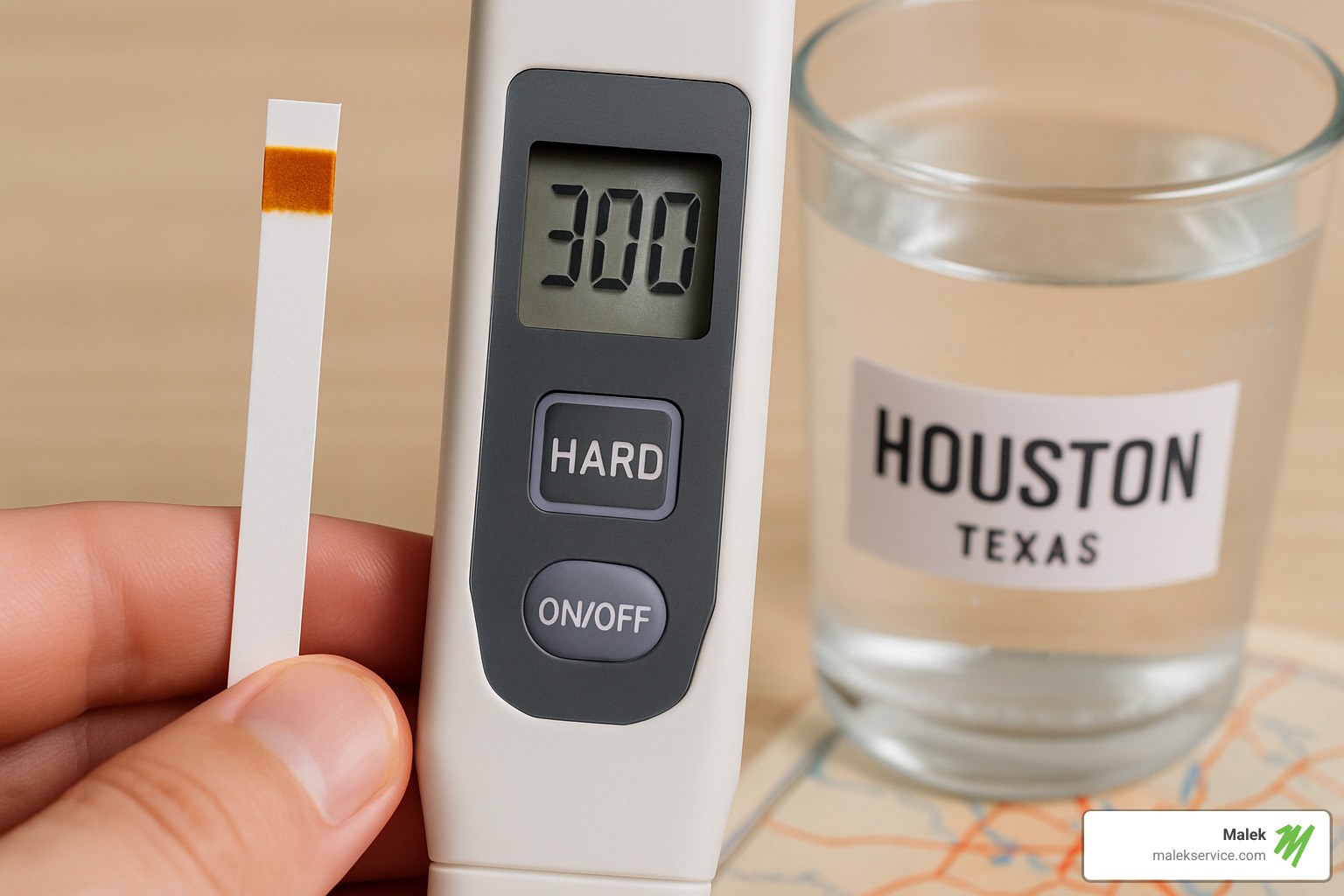
Hard water is a significant issue for Houston homeowners. The minerals in our water leave stubborn white buildup on faucets, damage appliances, and can make your skin feel dry and itchy. According to research, 85% of homes in the U.S. have hard water, and Houston ranks among the hardest with levels typically ranging from 140 to 300 ppm.
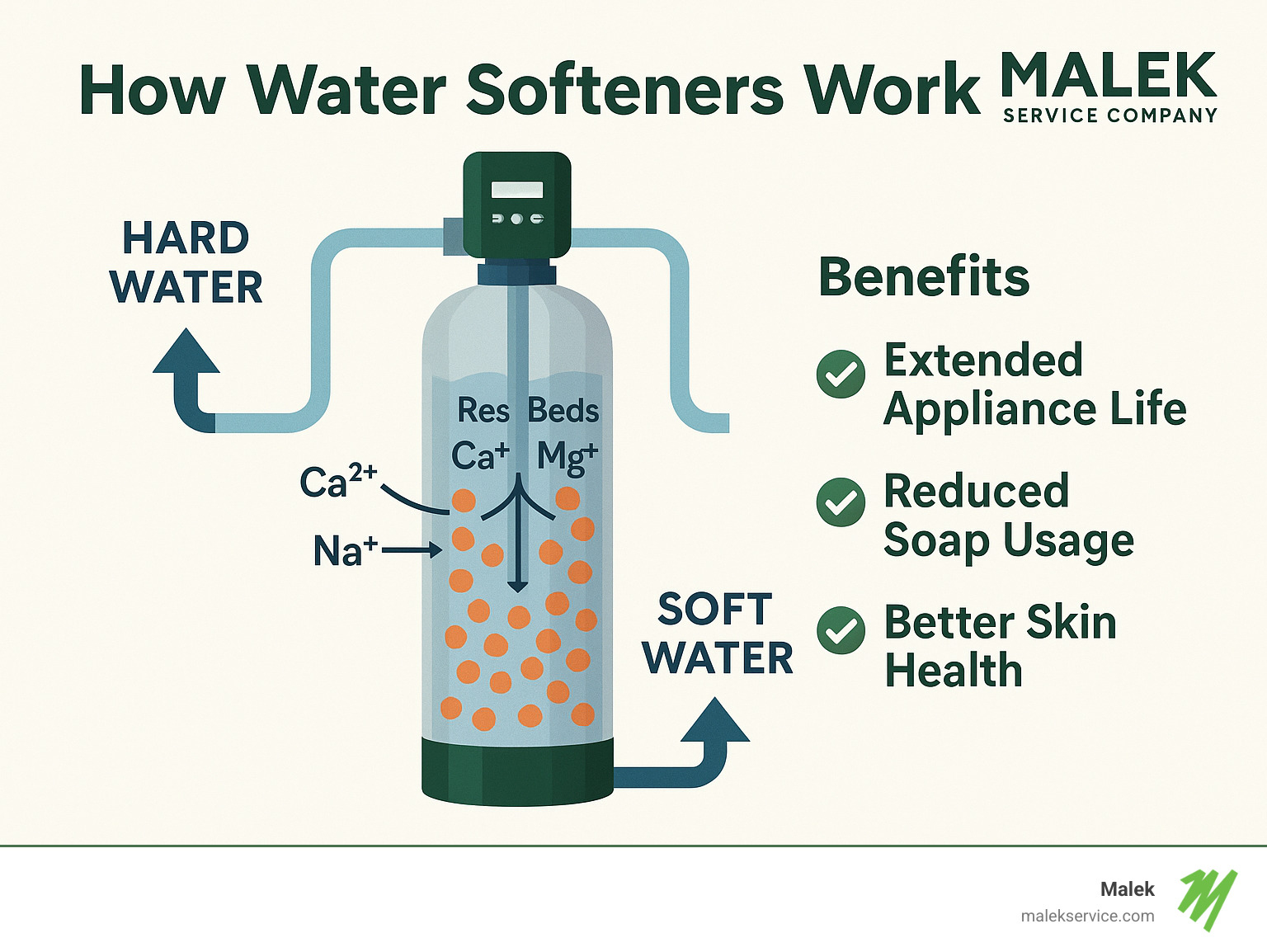
Water softeners work through a process called ion exchange, replacing the problematic calcium and magnesium ions with sodium or potassium. The result is water that feels smoother, creates better lather with soaps, and doesn’t leave scale deposits on your fixtures or inside your plumbing.
The benefits extend beyond comfort. Softened water can increase water heater efficiency by up to 30% and reduce detergent costs by up to 50% for laundry and cleaning. Many Houston homeowners also report softer skin, shinier hair, and brighter clothing after installing a quality water softener.
I’m Courtney Zalesak, and as Vice President at Malek Service Company, I’ve helped countless Houston residents solve their hard water problems by recommending appropriate Houston water softeners based on household size, water usage patterns, and specific water quality challenges.
Houston Water Softeners at a Glance
Looking for relief from Houston’s stubborn hard water? You’re not alone! Many homeowners are finding the difference that the right water softener can make in their daily lives. Let’s explore your options for tackling those pesky minerals.
Salt-based systems have earned their reputation as reliable workhorses, physically removing hardness minerals through ion exchange. If you prefer to avoid sodium, salt-free conditioners prevent scale buildup without adding anything to your water. For homes with multiple water concerns, dual systems brilliantly combine softening with filtration for comprehensive water treatment.
When helping Houston families choose the right system, I often share this comparison to make the decision easier:
| Feature | Salt-Based Systems | Salt-Free Conditioners | Dual Systems |
|---|---|---|---|
| How it works | Ion exchange | Template Assisted Crystallization (TAC) | Combines filtration and softening |
| Removes hardness minerals | Yes | No (crystallizes them) | Yes |
| Requires salt | Yes | No | Yes |
| Maintenance | Regular salt refills | Minimal | Salt refills and filter changes |
| Best for | Very hard water | Moderate hardness | Hard water with other contaminants |
| Cost range | $950-$1,850 | $1,450-$2,750 | $1,850-$2,750 |
| Lifespan | 10-15 years | 3-7 years for media | 10-15 years |
The investment in a quality Houston water softener typically pays for itself faster than you might think. Our customers are often surprised to find they’re using up to 50% less soap, detergent, and cleaning supplies after installation. Your water heater can operate up to 30% more efficiently without scale buildup, and appliances like dishwashers and washing machines enjoy significantly longer lifespans.
I recently installed a dual system for a family in the Heights, and the homeowner couldn’t wait to share her experience: “After installing a whole-house water softener, I immediately noticed the difference in my shower. No more dry, itchy skin, and my hair feels softer than it has in years.”
Want to know exactly what you’re dealing with? I always recommend checking the City of Houston’s Water Quality Report for baseline information about our local water. For the most accurate assessment of your specific situation, schedule a professional water test to determine your exact hardness level and identify any other contaminants lurking in your water.
The right Houston water softener not only protects your home and appliances but also delivers noticeable energy and detergent savings that most homeowners appreciate seeing on their monthly bills. Whether you choose salt-based, salt-free, or a comprehensive dual system, you’ll be taking a smart step toward improving your home’s water quality and comfort.
Salt-Based Ion Exchange Systems (Classic Workhorse)
If you’re dealing with Houston’s notoriously hard water, salt-based ion exchange systems are the tried-and-true champions that have been tackling mineral buildup for decades. These Houston water softeners are particularly effective against our region’s stubborn 140-300 ppm hardness levels.
These systems work through a surprisingly simple but neat process involving two main components:
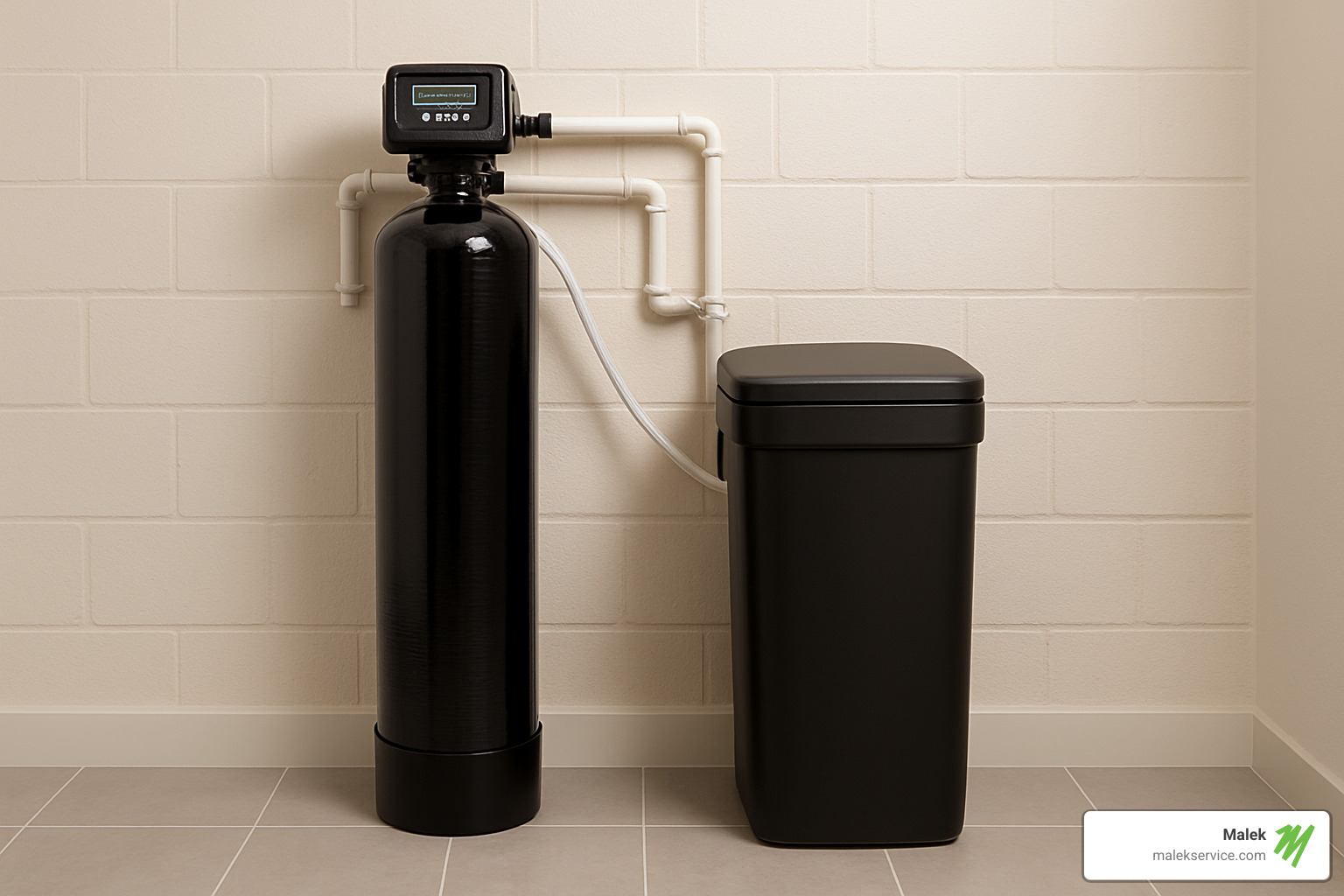
The resin tank houses thousands of tiny beads that are initially charged with sodium ions, while the brine tank stores and dissolves either regular salt (sodium chloride) or potassium chloride (a salt alternative).
When your hard water flows through the resin tank, something magical happens – the calcium and magnesium minerals responsible for all those spots on your dishes and buildup in your pipes get attracted to the resin beads. The beads happily trade sodium ions for these hardness minerals, sending softened water flowing through your home’s plumbing.
“I’ve installed hundreds of these systems across Houston,” shares Mike, one of our senior plumbing technicians at Malek. “Folks in places like Memorial and River Oaks with hardness levels above 10 grains per gallon see dramatic improvements almost immediately. The shower doors that were impossible to keep clean? Suddenly spotless.”
What keeps these systems working year after year is the regeneration process. When those resin beads get saturated with hardness minerals, the system automatically flushes them with the salt solution from the brine tank. This recharges the beads with fresh sodium ions and sends all those captured minerals down the drain.
Today’s salt-based softeners are smarter than ever, with digital controls that track your water usage patterns and only regenerate when truly necessary. This intelligent approach means these systems operate for pennies a day while saving you hundreds in reduced cleaning supplies, extended appliance life, and lower energy bills.
For more comprehensive information about protecting your plumbing system from hard water damage, take a look at our plumbing maintenance guide.
Pros & Cons
Salt-based systems offer impressive benefits for Houston homeowners. They completely remove hardness minerals rather than just neutralizing them, providing that distinctively slippery “soft water feel” that makes soap lather beautifully. With proper care, these workhorses last 10-15 years and can boost water heater efficiency by up to 30% – a significant energy savings in our hot climate.
The downsides? You’ll need to replenish the salt every 6-8 weeks, and the systems do produce some wastewater during regeneration cycles. There’s also a small amount of sodium added to your water, though this can be eliminated by using potassium chloride instead of traditional salt.
As Maria in Bellaire told us after her installation: “I was worried about having to lug bags of salt, but honestly, it’s become just a quick errand every couple of months. Seeing my faucets stay shiny and knowing my water heater isn’t filling with scale makes it completely worth it.”
Best For
Houston water softeners using salt-based ion exchange are particularly ideal if:
Your water hardness exceeds 10 grains per gallon (common throughout Houston and especially in areas like The Woodlands, Sugar Land, and Katy).
You have a large family with multiple bathrooms and high water usage – these systems can be properly sized to handle substantial demands without losing effectiveness.
You’re concerned about protecting expensive appliances – by completely removing hardness minerals, you’ll maximize the lifespan of everything from your coffee maker to your washing machine.
You prefer that classic soft water feel that makes skin and hair feel notably different after showering.
Your home has older plumbing already suffering from scale buildup – over time, a salt-based system can actually help dissolve existing scale, potentially saving you from extensive repiping work.
“What I tell my customers,” explains our Malek service manager, “is that while the upfront investment might seem significant, these systems typically pay for themselves within 2-3 years through extended appliance life, reduced cleaning product usage, and lower energy costs. For most Houston homes, they’re the most complete solution to our hard water challenges.”
Salt-Free Conditioning Systems (TAC & TGP)
Looking for a low-maintenance solution to Houston’s hard water problems? Salt-free water conditioning systems have become a popular choice for eco-conscious homeowners across the city. Unlike traditional softeners, these innovative systems don’t actually remove minerals from your water – they transform them instead!
These Houston water softeners work by changing the chemical structure of hardness minerals, preventing them from forming that stubborn scale we all hate seeing on our faucets and showerheads.
“My plants are thriving since I switched to a salt-free system,” shares Maria from Montrose. “I no longer worry about sodium-rich water damaging my garden, and my shower stays spotless!”
The two main technologies you’ll encounter in the salt-free world are:
Template Assisted Crystallization (TAC) uses special polymer beads with tiny templates that convert dissolved calcium and magnesium into microscopic crystals. These harmless crystals remain suspended in your water rather than sticking to your pipes and appliances. Think of it as turning those troublesome minerals into tiny snowflakes that flow right through your plumbing!
Turbulent Galvanic Polarization (TGP) represents newer technology that’s making waves in Houston homes. TGP systems use specialized media (certified by IAPMO R&T) that alters the electrical charge of hardness minerals, neutralizing their ability to form scale for up to three years.
What makes these systems particularly attractive to Houston homeowners? They require no electricity, produce zero wastewater, and don’t add a single grain of sodium to your drinking water. For those interested in the science behind hard water problems, check out this fascinating scientific research on hard-water scale that explains why 85% of U.S. homes struggle with these issues.
How They Work
The magic of salt-free conditioning happens through neat scientific processes that are fundamentally different from traditional softeners.
With Template Assisted Crystallization (TAC) systems, your hard water passes through specially designed polymer beads. These beads contain microscopic “nucleation sites” that act like magnets for dissolved calcium and magnesium. As these minerals attach to the sites, they form tiny crystals that eventually break free and remain suspended in your water.
“It’s nature’s own solution to hard water,” explains our senior technician at Malek. “The minerals stay in your water – which is actually good from a health perspective – but they lose their ability to cause problems.”
Turbulent Galvanic Polarization (TGP) technology takes a different approach. When your water flows through the specialized media bed, it creates what’s called a galvanic effect. This essentially changes the electrical charge of those pesky hardness minerals, rendering them unable to stick to surfaces. The best part? This protective effect continues throughout your entire home’s plumbing system.
Unlike their salt-based cousins, these systems don’t need electricity to operate. They don’t require backwashing or regeneration cycles either, making them incredibly low-maintenance options for busy Houston families.
The main difference you’ll notice? Conditioned water doesn’t have that distinctively slippery feel that softened water provides. However, for preventing scale buildup in pipes, extending the life of water heaters, and keeping fixtures sparkling clean, these systems deliver impressive results.
Best For
Salt-free conditioning systems shine in specific Houston households:
Homes with moderate hardness levels benefit most from these systems. While they work across the hardness spectrum, they’re particularly effective when your water tests under 15 grains per gallon – common in many Houston neighborhoods.
Health-conscious families often prefer salt-free options. Since these systems preserve beneficial minerals like calcium and magnesium while preventing scale, they’re perfect for those monitoring sodium intake or wanting naturally mineral-rich water.
Environmentally minded homeowners appreciate that these systems use no water for regeneration and don’t discharge salt into our local watersheds. In drought-prone Texas, this water conservation aspect is increasingly important.
Busy professionals love the hands-off maintenance. Without monthly salt refills or regeneration cycles to monitor, these systems typically need just an annual check-up to keep performing optimally.
Homes with septic systems benefit from the absence of backwash cycles, making these conditioners completely septic-safe – a significant advantage for properties outside Houston’s main sewage infrastructure.
Smaller homes or condos with limited installation space can take advantage of salt-free systems’ compact footprint, as they don’t require separate brine tanks.
A Malek customer in The Heights recently told us: “After years of lugging heavy salt bags, my salt-free system feels like freedom! My shower heads stay clean, my appliances run better, and I never have to think about maintenance. It’s the perfect solution for my busy lifestyle.”
We’ve installed numerous salt-free systems throughout Houston, from Brazos County to Grimes County, where homeowners value both water quality and environmental responsibility. These systems truly represent a perfect balance of effectiveness, convenience, and eco-friendly design.
Dual Softener + Filtration Combos
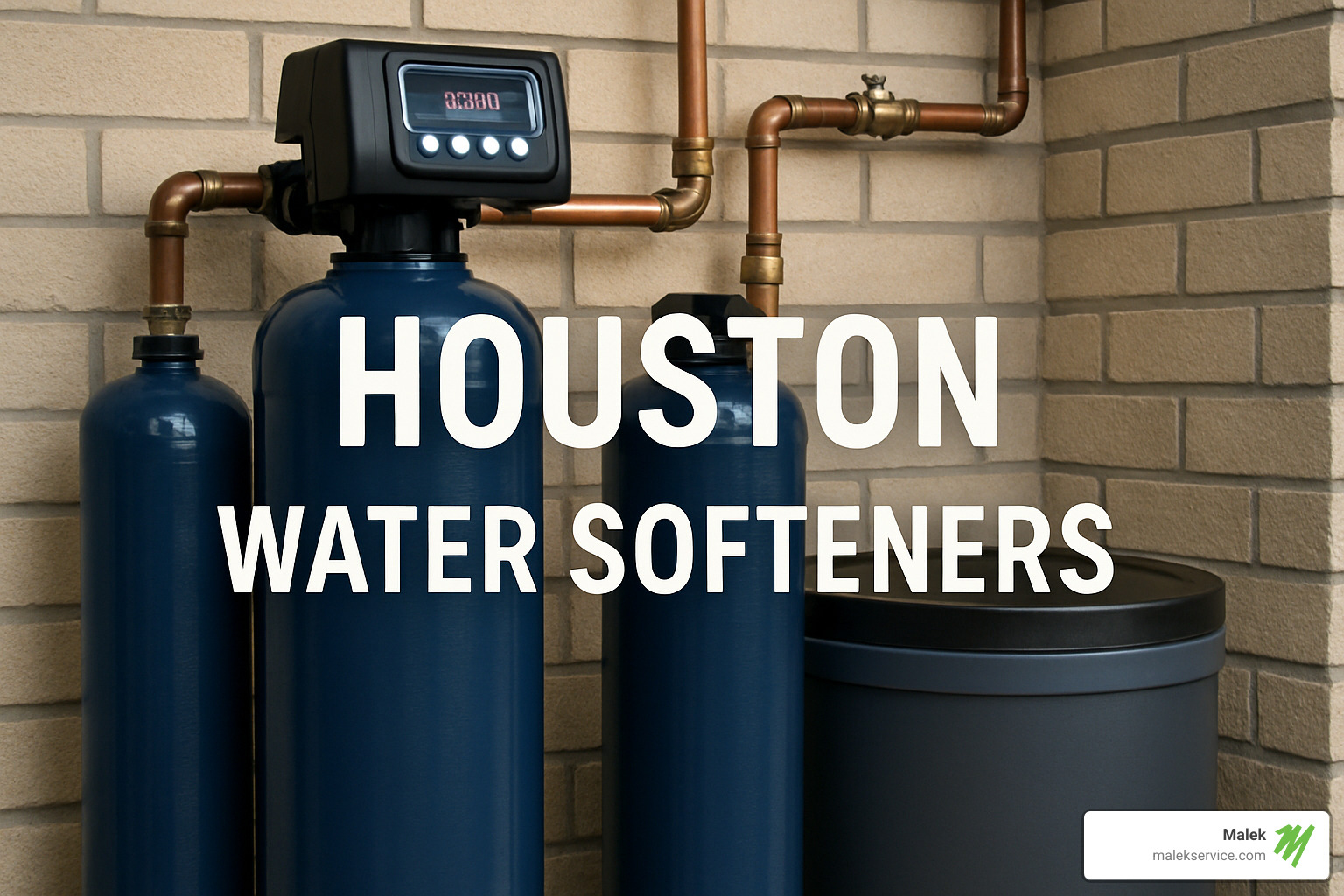
Why choose between soft water and clean water when you can have both? That’s the beauty of dual softener and filtration combination systems, which have become the go-to solution for many Houston homeowners looking for complete water treatment in one package.
These clever all-in-one Houston water softeners tackle both our notorious hard water minerals and other water quality issues simultaneously. It’s like getting a two-for-one deal on better water!
Most dual systems include a smart three-part approach:
First, a carbon pre-filter removes chlorine, chloramines, and organic compounds that make your water taste and smell funky. Next, the softening media works its magic on those troublesome hardness minerals through either ion exchange or conditioning. Some premium systems even add a third “polishing” stage for extra contaminant removal.
“Houston’s water isn’t just hard—it also contains chlorine, chloramines, and in some areas near the San Jacinto River, we even find traces of PFAS,” explains one of our Malek water quality specialists. “Dual systems are so popular because they address all these concerns in one efficient package.”
The best professional-grade systems can handle up to 400,000 gallons of chlorine before needing media replacement. That’s particularly valuable in our city, where municipal water treatment involves significant disinfection chemicals.
Having everything integrated in a single tank isn’t just convenient—it’s smart engineering. As our water treatment experts at Malek point out, “Our premium systems use smart regeneration technology that adjusts automatically based on your actual water usage.”
For homeowners worried about both scale damage and potential contaminants in their water, take a moment to learn more about plumbing system dangers that might be affecting your home’s water quality.
Added Benefits
The beauty of dual systems is that they deliver benefits you simply can’t get with standalone Houston water softeners. Let me share some of the advantages our customers rave about:
Your skin and hair will thank you! By removing both hardness minerals and chlorine, dual systems create water that’s genuinely gentle on skin and hair. I’ve had customers with chronic skin conditions report remarkable improvements after installation.
“Since installing our dual system, my daughter’s eczema has improved dramatically,” a Malek customer from Spring told us recently. “Her pediatrician was amazed at the difference and now recommends water treatment to other patients with similar skin issues.”
Your equipment lasts longer too. The carbon pre-filtration stage protects the softening resin by removing chlorine and chloramines that would otherwise cause degradation. Our water treatment specialists at Malek note that this smart design can extend resin life “up to four times longer than systems without pre-filtration.”
The taste improvement is noticeable throughout your home. Traditional softeners address hardness but don’t touch taste or odor issues. Dual systems handle both, giving you better-tasting water from every tap.
Many health-conscious Houston families appreciate the reduced chemical exposure. By removing chlorine, chloramines, and sometimes even PFAS (those persistent “forever chemicals”), these systems minimize exposure to potentially harmful substances during showering when absorption through skin and steam inhalation can occur.
Maintenance becomes much simpler with these integrated systems. Instead of servicing multiple separate units, you’re maintaining just one system with synchronized service schedules. As one Malek water treatment technician put it, “It’s like having one smart water treatment command center instead of separate devices that don’t talk to each other.”
Space efficiency is another practical benefit, especially valuable in Houston homes where utility room real estate is at a premium. Many dual systems require significantly less floor space than separate softener and filter installations.
The satisfaction numbers speak volumes: in a recent customer survey, 92% of Houston homeowners with dual systems reported being “very satisfied” with their water quality improvement, compared to 78% satisfaction with single-function systems.
Portable & Point-of-Use Options
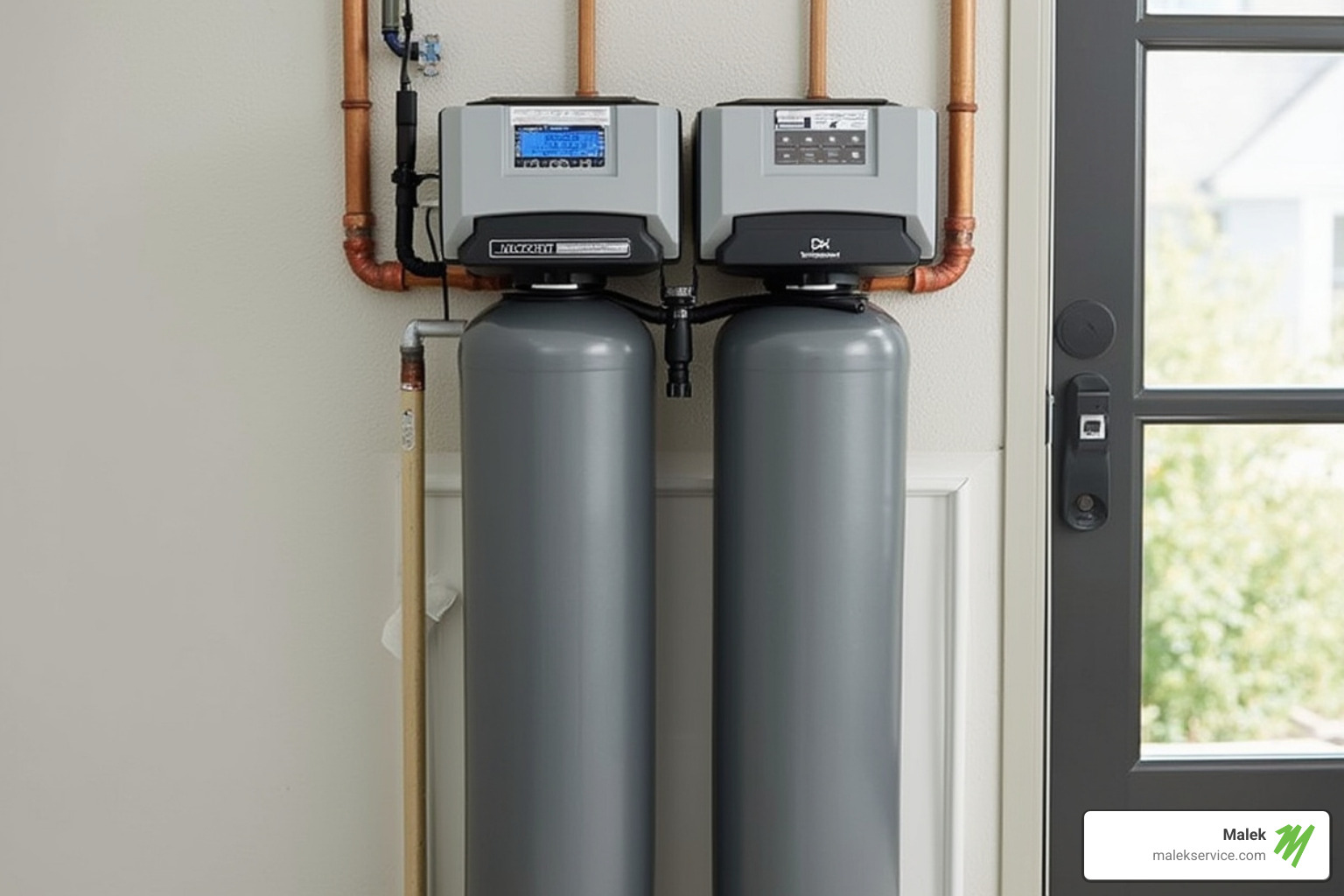
Not everyone in Houston has the space, budget, or permission to install a whole-house water softening system. If you’re renting, living in an apartment, or just want to try softened water without a major commitment, portable and point-of-use Houston water softeners might be your perfect solution.
These smaller, targeted options help you enjoy the benefits of softer water exactly where you need it most.
“I was tired of dealing with spotty dishes and dry skin, but as a renter, I couldn’t install anything permanent,” shares Maria, a Houston Heights apartment dweller. “My countertop water softener changed everything—and I can take it with me when I move!”
Under-sink reverse osmosis (RO) systems are particularly popular in Houston. These compact units fit neatly beneath your kitchen sink and provide incredibly pure drinking and cooking water. They remove up to 99% of contaminants, including those pesky hardness minerals. At $300-600, they’re a significant upgrade from bottled water in both convenience and long-term cost.
For those with even tighter budgets, countertop water softener cartridges offer a simple solution. These connect to standard faucets with no tools required and use small resin cartridges to soften water for dishwashing and food preparation. Many Houston renters appreciate being able to make this improvement without risking their security deposit.
Shower head filters represent the most accessible entry point to water treatment. While they don’t technically soften water, they do reduce chlorine and some minerals, making a noticeable difference for your skin and hair. At just $30-80, they’re an affordable first step that many Houston residents take before investing in more comprehensive solutions.
For RV owners or those with weekend homes in the Hill Country, portable RV/marine softeners provide flexible protection against the extremely hard water found throughout Texas. These compact units regenerate quickly and can travel wherever you do.
When to Choose
Point-of-use Houston water softeners make perfect sense in several specific situations.
If you’re renting or living in an apartment, these removable options let you enjoy better water without permanent modifications. James from Montrose told us, “My landlord wouldn’t allow whole-house changes, but my countertop filter has made cooking and coffee so much better—I can actually taste the difference!”
Many homeowners start with these smaller systems before committing to a whole-house solution. It’s a practical way to experience the benefits of softened water with a smaller upfront investment. You can literally dip your toe in before diving all the way in.
Even in homes with whole-house softeners, an under-sink RO system often provides that extra level of purification for drinking water. This combination approach ensures you have the perfect water quality for every use throughout your home.
Sometimes you just need to solve one specific problem area. If your shower heads constantly clog with scale or your kitchen faucet is developing an unsightly white crust, a targeted solution can address these issues economically without treating water you don’t need to treat.
For vacation properties or weekend homes that sit empty much of the time, portable systems offer the perfect balance of protection without the maintenance requirements of permanent installations.
At Malek, we often recommend starting with a shower filter and under-sink RO system for customers who aren’t quite ready for whole-house treatment. This approach delivers immediate benefits where water quality matters most—your drinking water and daily shower—while allowing you to plan for a more comprehensive solution down the road.
As our water specialist likes to say, “Better water doesn’t have to be an all-or-nothing proposition. Start where you need it most, and you can always expand later.”
Commercial & High-Capacity Solutions
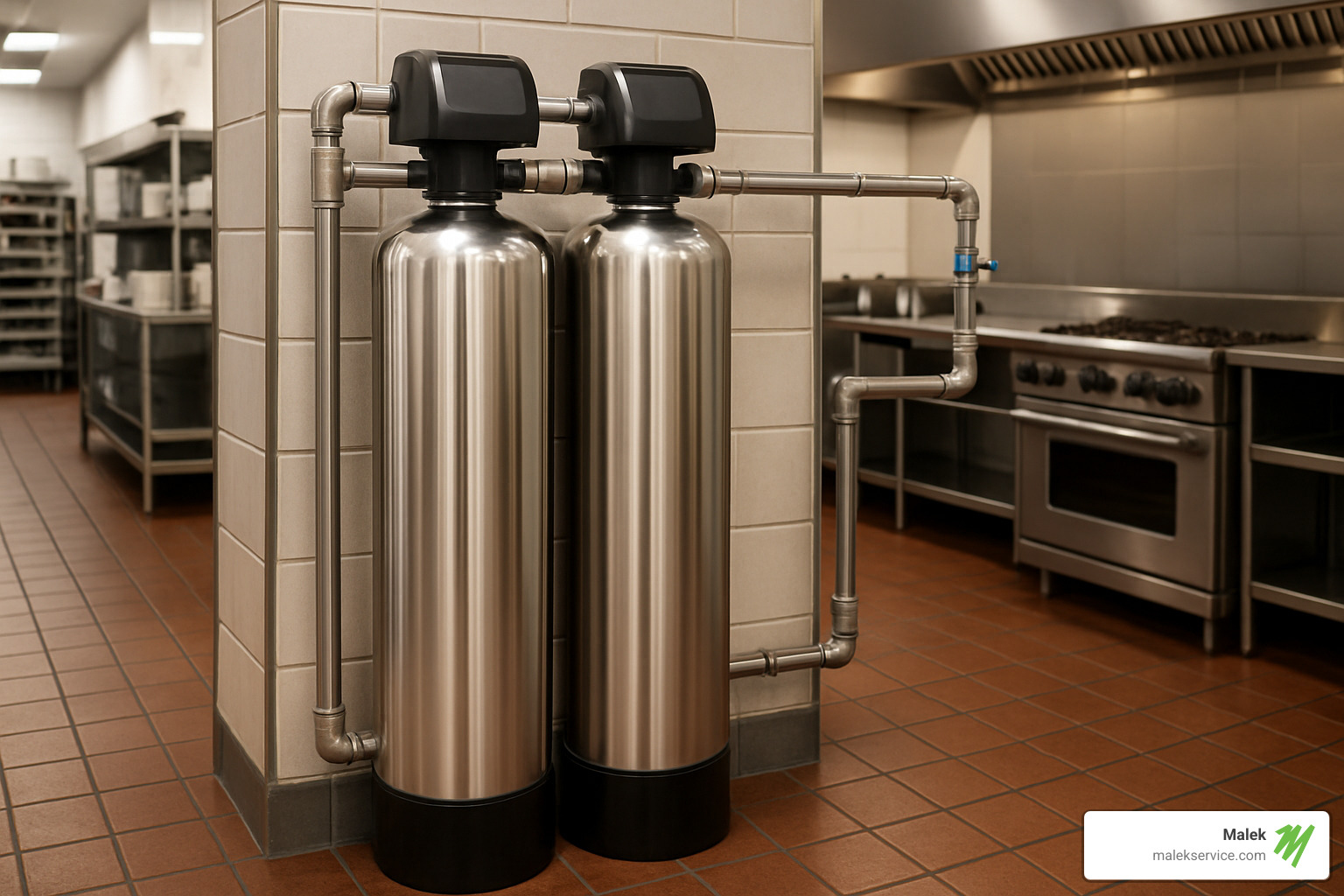
When it comes to Houston businesses, water quality challenges demand a different level of solution than residential properties. From busy restaurants and hotels to busy laundromats and manufacturing facilities, commercial Houston water softeners need to handle higher flow rates and withstand constant usage.
Commercial water softening systems come with features designed specifically for business needs. Most notably, they typically include twin-alternating tank designs that ensure your business never experiences interruptions in soft water service. While one tank regenerates, the other remains active – a crucial feature during peak business hours when water demand is highest.
“For our restaurant clients in Houston, we typically recommend high-capacity systems with flow rates of at least 25 gallons per minute,” explains our Malek commercial service manager. “This ensures adequate water pressure even during the lunch rush when dishwashers are running constantly.”
Today’s commercial systems also feature sophisticated digital controls that monitor actual water usage patterns and adjust regeneration cycles accordingly. These smart controls maximize efficiency while minimizing salt consumption and water usage – helping your bottom line while being environmentally responsible.
When sizing a commercial system for a Houston business, we consider several critical factors:
– Your business’s peak flow rate requirements
– Daily water consumption patterns
– Normal operating hours
– The hardness level of your incoming water
– Any space constraints in your facility
For businesses like hotels and laundromats where water quality directly impacts both customer satisfaction and equipment longevity, properly sized commercial water softeners aren’t just helpful – they’re essential investments.
If you’d like to learn more about commercial plumbing solutions for your Houston business, visit our Plumbing Houston page for detailed information.
ROI for Businesses
The return on investment for commercial Houston water softeners often proves even more dramatic than for residential installations. Businesses that invest in proper water treatment typically see benefits that directly impact their profitability.
Equipment downtime can be catastrophic for businesses. Without water softeners, commercial appliances like ice machines, dishwashers, steamers, and laundry equipment fall victim to scale buildup at alarming rates. One commercial kitchen equipment supplier in Houston shared with us: “Restaurants without water softeners typically call for service on their ice machines and dishwashers 3-4 times more frequently than those with proper water treatment.”
The equipment lifespan equation is simple but powerful. Commercial water-using equipment represents a significant capital investment for most businesses. Water softeners can extend the useful life of this equipment by 30% or more, according to industry studies – postponing expensive replacements and upgrades.
Utility savings add up quickly for businesses. What many business owners don’t realize is that even a modest ¼ inch of scale buildup in heating elements can increase energy costs by up to 40%. For businesses operating multiple water heaters, boilers, or steam equipment, these savings become substantial very quickly.
Businesses like commercial laundries and restaurants can reduce detergent and chemical usage by up to 50% with properly softened water. Month after month, these operational savings contribute directly to improved profit margins.
For businesses where water directly affects the end product – think restaurants, coffee shops, and breweries – water softening improves both consistency and quality. As one Houston café owner told us after installing a commercial softener: “Our espresso tastes better and our machine needs descaling far less often. Our customers notice the difference, even if they don’t know why.”
The typical payback period for commercial water softening systems ranges from 12-24 months, making them one of the most cost-effective infrastructure investments a Houston business can make. After that point, the system continues delivering savings directly to your bottom line.
Frequently Asked Questions about Houston Water Softeners
Are Houston water softeners safe for drinking water?
Yes, you can absolutely drink water from your softening system with confidence! When it comes to traditional salt-based Houston water softeners, they work through a simple exchange process—they swap out those troublesome calcium and magnesium minerals for sodium. But don’t worry about consuming too much sodium—we’re talking about minimal amounts here, typically around 12.5 mg per 8-oz glass in our very hard Houston water.
To put that in perspective, a single slice of bread contains about 170 mg of sodium—that’s more than 13 times what’s in your glass of softened water! The EPA has confirmed softened water is perfectly safe for drinking, and the sodium levels fall well within normal dietary guidelines.
“Many of my customers are initially concerned about sodium in their drinking water, but when I explain how minimal it is, they feel much better about it,” shares one of our Malek technicians.
If you’re on a strict low-sodium diet, you still have great options:
You can use potassium chloride instead of regular salt in your softener. It costs a bit more but eliminates sodium completely. Another popular approach is installing a bypass for your kitchen cold water line, so your cooking and drinking water remain unsoftened. Many Houston families choose to add an under-sink reverse osmosis system that removes even that tiny bit of sodium along with other potential contaminants.
How long do Houston water softeners last and what maintenance is required?
With proper care, your Houston water softeners can faithfully serve your home for 10-15 years. Think of them like a reliable car—the better you maintain them, the longer they’ll run smoothly!
The lifespan of your system depends on several factors including your water’s hardness level, the quality of the system you choose, your household’s water usage, and how diligently you keep up with maintenance.
For salt-based systems, maintenance is straightforward but important. You’ll need to refill the salt every 6-8 weeks (depending on your water usage), clean the resin annually with a proper cleaner to remove iron buildup, clean the brine tank every year or two to remove salt bridges and sediment, and have the control valve and settings checked annually.
Salt-free conditioners are even lower maintenance, typically requiring media replacement every 3-7 years and pre-filter changes every 3-12 months based on your local water conditions. An annual professional check-up is still recommended to ensure everything’s working properly.
“The most common issue we see with Houston water softeners is people simply forgetting to add salt,” one of our Malek technicians notes with a smile. “It’s like forgetting to put gas in your car and wondering why it stopped running!”
Many of our Houston customers find peace of mind with our Houston Plumbing Maintenance Plans that include regular water softener service and reminders.
What is the difference between water softening and water filtration?
Softening and filtration are like two different heroes tackling different villains in your water—they’re often confused, but they serve distinct purposes.
Water softening focuses specifically on removing those pesky hardness minerals—calcium and magnesium—that cause scale buildup in your pipes and appliances. Using either ion exchange or crystallization technology, softeners prevent the crusty white deposits on your fixtures, make soap lather better, and protect your appliances from premature failure. However, softeners aren’t designed to remove contaminants like chlorine, lead, or bacteria.
Water filtration, on the other hand, is all about removing unwanted chemicals, contaminants, and particles from your water. Using materials like carbon, ceramic, or specialized membranes, filtration systems improve taste and odor and remove potentially harmful substances. But most filtration systems don’t address water hardness at all.
“I explain it to my customers like this,” says our Malek water quality specialist, “softening deals with the minerals, while filtration handles the chemicals and contaminants. It’s why so many Houston homes benefit from having both.”
This explains the growing popularity of dual systems in Houston homes. They combine both technologies to give you water that’s not only soft and scale-free but also clean, great-tasting, and free of unwanted chemicals.
For families with specific concerns beyond hardness—like chlorine taste, lead from older plumbing, or emerging contaminants like PFAS—a combination approach provides the most comprehensive solution for truly healthy, high-quality water throughout your home.
Conclusion
Investing in a quality Houston water softener is one of the smartest moves you can make for your Houston home. It’s not just about preventing those annoying white spots on your faucets – it’s about protecting your investment and improving your daily life in countless ways.
Throughout this guide, we’ve explored how Houston’s particularly hard water (140-300 ppm!) can wreak havoc on everything from your morning shower experience to the lifespan of your major appliances. The good news? You have options that fit every home, budget, and preference:
Salt-based systems remain the gold standard for homes battling our region’s extremely hard water. They completely remove those troublesome minerals through ion exchange, giving you that classic soft water feel that many Houston families love.
Salt-free conditioners offer a wonderful alternative if you’re environmentally conscious or looking to minimize maintenance. While they don’t remove minerals, they effectively prevent scale buildup without adding sodium or wasting water.
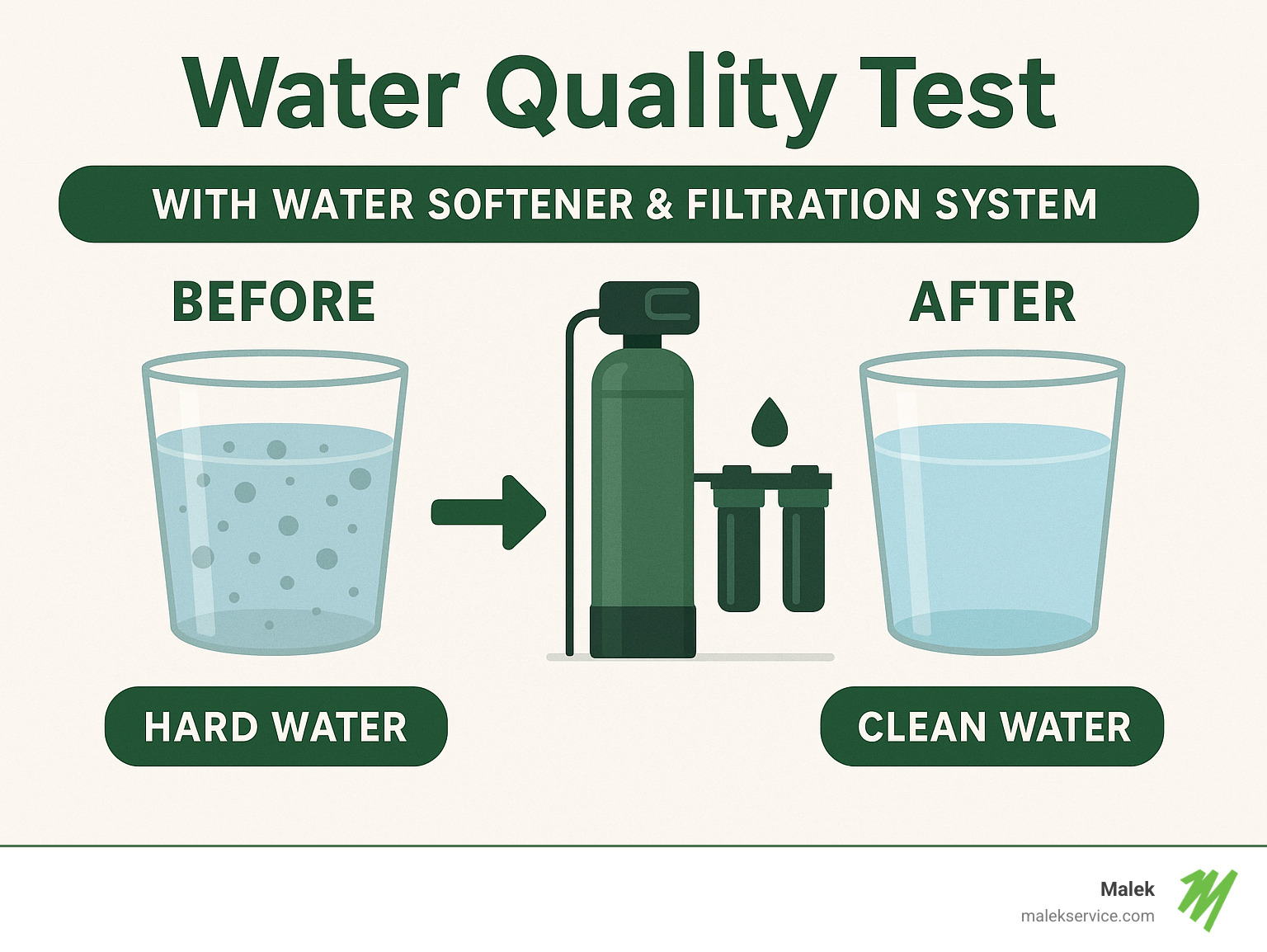
Dual softener-filtration systems provide the ultimate water quality solution, addressing both hardness minerals and other contaminants in one efficient package. These systems are perfect for families concerned about both scale damage and water taste.
Point-of-use options give renters and those with limited space targeted solutions where they matter most – whether that’s your kitchen sink or master bathroom shower.
Commercial systems deliver the heavy-duty performance that Houston businesses need to protect expensive equipment and provide quality water to customers.
I’ve seen how transformative a properly sized and installed water softening system can be for Houston families. Customers regularly tell me about softer skin, brighter clothes, and the satisfaction of seeing their appliances running efficiently year after year.
At Malek Service, our licensed technicians understand the unique water challenges facing different Houston neighborhoods. The water in The Woodlands isn’t identical to what flows through pipes in Sugar Land or Pearland, and we tailor our recommendations accordingly.
While DIY kits are available, professional installation ensures your system is correctly sized for your home’s specific needs and water hardness level. This maximizes efficiency and extends the life of your investment.
Don’t let Houston’s notoriously hard water continue damaging your home and affecting your quality of life. The sooner you address your water quality issues, the more you’ll save – not just in appliance repairs and detergent costs, but in everyday comfort and convenience.
For more information about professional water softener installation and service in Houston, visit our Plumbing Houston page. Our team is ready to help you enjoy the benefits of limescale-free living with a water treatment solution perfectly matched to your home’s needs.